Posted on Leave a comment

Semiconductors

Topic Tree (Ignore Deleted Portions)

Semiconductor Devices

├── Semiconductors
│ ├── Intrinsic
│ │ └── Pure Semiconductor
│ ├── Extrinsic
│ │ └── p-type and n-type Semiconductor
│ ├── Valence Band
│ ├── Conduction Band
│ ├── Energy Gap
│ ├── PNP
│ │ └── CE mode
│ └── NPN
│ ├── CB mode
│ └── CC mode

├── Transistors
│ (linked from Semiconductor → PNP/NPN structure)

├── Junction Diodes
│ ├── PN-Junction Diode
│ │ ├── Potential Barrier and Field
│ │ ├── Depletion Region
│ │ └── Rectifier (Half Wave & Full Wave)
│ │ └── Filter
│ ├── Zener Diode
│ │ ├── I–V Characteristics
│ │ └── Voltage Regulator
│ ├── Photo Diode
│ └── LED

└── Logic Gates
├── NAND
├── AND
├── OR
├── NOR
└── NOT

SaitechAI • Electronics Lecture Cards (Compact)

SaitechAI • Electronics Lecture Cards

Energy Bands → Semiconductors → PN Junction → Biasing → Rectifiers

EB

Energy Band Theory

VB • CB • Forbidden gap (Eg)
Concept
  • In crystals, atomic levels spread into bands.
  • VB: highest filled, CB: next higher; Eg has no states.
  • Fermi level EF: 50% occupancy at equilibrium.
Conductor SemiconductorEg Insulator Conduction requires carriers + empty states near EF
CMP

Conductors vs Semiconductors vs Insulators

σ(T), carriers, EF
PropertyConductorSemiconductorInsulator
Band pictureVB overlaps CBSmall Eg (~0.7–3 eV)Large Eg (>~5 eV)
CarriersElectronse⁻ & h⁺Bound
σ vs T↓ with T↑ with T≈0
Why σ↑ with temperature in semiconductors? Thermal energy generates e⁻–h⁺ pairs (VB→CB), increasing carrier density.
SC

Intrinsic & Extrinsic Semiconductors

Fermi level shift • Majority carriers
  • Intrinsic: n = p = ni, EF ≈ mid-gap; σ = q(nμn+pμp).
  • n-type: donors → electrons majority; EF ↑ toward CB.
  • p-type: acceptors → holes majority; EF ↓ toward VB.
  • Mass action: np=ni2.
Intrinsic EF n-type EF
PN

PN Junction • Equilibrium

Depletion region • Vbi
  • Diffusion leaves fixed ions → depletion with built-in potential Vbi.
  • Equilibrium: drift current = diffusion current.
Vbi = (kT/q) ln(NaNd/ni2)
pn Depletion
FB

Forward Bias

Diode equation & knee
  • p→+, n→− lowers barrier, width ↓, large I after threshold.
  • I = Is(e^{VD/(nVT)} − 1)
  • VT≈25.9 mV @ 300 K; n≈1–2.
+
RB

Reverse Bias

Leakage • Breakdown
  • p→−, n→+ raises barrier; I ≈ Is (tiny) till breakdown.
  • Zener/avalanche at high |VR|.
HWR

Half-Wave Rectifier

Single diode • High ripple
  • Average DC: Vdc=Vm; Ripple factor ≈1.21; η ≈40.6%; PIV =Vm.
R
FWR

Full-Wave Rectifier

Bridge • Low ripple
  • Average DC: Vdc=2Vm; Ripple ≈0.482; η ≈81.2%.
  • PIV: bridge Vm, centre-tap 2Vm.
R
QP

Quick Practice

Check-your-understanding
  1. Why do insulators show negligible conductivity at room temperature?
  2. In B-doped Si, identify majority/minority carriers.
  3. Write diode I–V equation and define symbols.
  4. Bridge FWR with Vm=12 V → Vdc?
  5. Define PIV; give values for HWR and centre-tap FWR.
Answers
  • Large Eg, no states near EF, no free carriers.
  • p-type: holes majority; electrons minority.
  • I = Is(e^{VD/(nVT)}−1); Is: saturation, n: ideality, VT=kT/q.
  • Vdc=2Vm/π≈7.64 V.
  • HWR: Vm; centre-tap FWR: 2Vm.
SUM

One-Page Summary

From bands to rectifiers
  • Metals: band overlap; Semis: small Eg; Insulators: large Eg.
  • Doping shifts EF, sets majority carriers.
  • PN junction: depletion + Vbi; bias controls barrier/current.
  • Rectifiers: HWR (simple, high ripple) vs FWR (better DC, lower ripple).
Attribution: SaitechAI

Interactivities

Word Search

Cross Word Puzzle

Posted on Leave a comment

Concave and Convex Mirrors Worksheet

Concept

A concave mirror is a part of a sphere with reflecting surface on the inner side. Parallel rays near the principal axis converge to the focal point , lying at a distance  from the pole . Center of curvature is  with radius .

Worksheet

SaitechAI • Concave Mirror – Concept & Worksheet (MathJax Enabled)

Concave Mirror – Concept & Application Worksheet

Mirror formula • Cartesian sign convention • Magnification • Practice problems (solutions hidden)

Concept

Concave (Converging) Spherical Mirror

A concave mirror is a part of a sphere with reflecting surface on the inner side. Parallel rays near the principal axis converge to the focal point \(F\), lying at a distance \(f\) from the pole \(P\). Center of curvature is \(C\) with radius \(R\).

  • Focal length: \( f = \dfrac{R}{2} \)
  • Magnification: \( m = \dfrac{h_i}{h_o} = \dfrac{v}{u} \)
  • Image nature: Depends on object position (beyond \(C\), at \(C\), between \(C\) and \(F\), at \(F\), between \(F\) and \(P\)).
Formula

Mirror Formula

For paraxial rays (small aperture), object distance \(u\), image distance \(v\), focal length \(f\):

\(\displaystyle \frac{1}{f}=\frac{1}{v}+\frac{1}{u}\)

Linear magnification: \(m=\dfrac{v}{u}\). For real inverted images, \(m<0\); for virtual erect images, \(m>0\).

Convention

Cartesian Sign Convention

  • Principal axis is the positive x-axis to the right; pole \(P\) at origin.
  • Distances measured towards the light (incident side, left of mirror) are negative.
  • Distances measured to the right of the mirror are positive.
  • For concave mirror: \(f\) and \(R\) are negative.
  • Heights above axis positive; below axis negative.
How to Solve

Quick Procedure

  1. Assign signs to \( (u, v, f) \) using the convention.
  2. Apply \( \left( \frac{1}{f} = \frac{1}{v} + \frac{1}{u} \right) \) to find the unknown distance(s).
  3. Use \( \left( m = \frac{v}{u} = \frac{h_i}{h_o} \right) \) for size relation, if needed.
  4. Conclude nature: real/virtual (sign of \( v \)), erect/inverted (sign of \( m \)).
Worksheet

Practice Problems (NCERT/AI – adapted)

6) An object is placed before a concave mirror of focal length 15 cm. The image is three times the size of the object. Find the two possible object distances from the mirror.

\(m = \frac{v}{u} = -3\) or \(+3\). Mirror formula \( \frac{1}{f} = \frac{1}{v} + \frac{1}{u}\), \(f = -15\).
For \(m = -3\): \(u = \frac{(1+m)}{m}f = \frac{(1-3)}{-3}(-15) = -10\) cm, \(v = mu = -30\) cm.
For \(m = +3\): \(u = \frac{(1+m)}{m}f = \frac{4}{3}(-15) = -20\) cm, \(v = +60\) cm.
Hence possible object distances: **10 cm and 20 cm** in front of mirror.

7) A convex rear-view mirror of radius 2 m shows a jogger approaching at 5 m/s. Find the speed of the image when the jogger is at (a) 39 m (b) 29 m.

\(f = +1\) m, \(u = -x\). \(v = \frac{fu}{u-f} = \frac{x}{x+1}\). Differentiate: \(\frac{dv}{dt} = \frac{1}{(x+1)^2}\frac{dx}{dt}\). \(dx/dt=-5\).
(a) \(x=39 \Rightarrow |dv/dt| = \frac{5}{40^2}=3.1\text{ mm/s}\); (b) \(x=29 \Rightarrow 5.6\text{ mm/s}\).

8) A mobile phone along the principal axis of a concave mirror forms distorted images. Explain why magnification is non-uniform.

Each point on the phone lies at different \(u_i\). Since \(1/f=1/v_i+1/u_i\), each part forms at different \(v_i\). So \(m_i = v_i/u_i\) varies along the length → non-uniform magnification → distortion.

9) Find object distance from a concave mirror (R = 20 cm) for a real image of magnification 2.

\(f = -10\) cm, \(m = -2\). \(v = mu = -2u\). \(1/f = 1/v + 1/u = 1/(-2u)+1/u = 1/(2u)\Rightarrow u=-5\) cm, \(v=-10\) cm. Hence image real and magnified.

10) Derive the mirror formula using a ray diagram for a concave mirror forming a real magnified image.

Using geometry of similar triangles \( \triangle A’B’F \sim \triangle ABF \): \( \frac{AB}{A’B’} = \frac{BF}{B’F} \Rightarrow \frac{1}{f}=\frac{1}{v}+\frac{1}{u}\).

11) (a) Draw ray diagram for real, inverted, magnified image by concave mirror. (b) Write mirror formula and magnification.

(a) Object between \(C\) and \(F\) → image beyond \(C\), inverted and magnified.
(b) \( \frac{1}{f}=\frac{1}{v}+\frac{1}{u},\quad m=\frac{h_i}{h_o}=\frac{v}{u}. \)
SaitechAI • Physics Worksheet • Click “Show / Hide Solution” to reveal answers.

SaitechAI • Convex Mirror – Concept Notes
Physics Notes

Convex Mirror – Concept and Key Points

1. Definition

A convex mirror is a spherical mirror whose reflecting surface is bulged outward. It diverges the rays of light that fall on it and hence it is also called a diverging mirror.

2. Focal Length and Radius of Curvature

  • Centre of curvature \( C \) lies behind the mirror.
  • Focal point \( F \) also lies behind the mirror.
  • For convex mirror, both \( f \) and \( R \) are taken as positive according to the Cartesian sign convention.
  • Relationship: \( f = \dfrac{R}{2} \)

3. Mirror Formula

The same mirror equation applies: \[ \frac{1}{f} = \frac{1}{v} + \frac{1}{u} \] where \( f \) = focal length, \( u \) = object distance, \( v \) = image distance.

4. Sign Convention (Cartesian)

  • Distances measured opposite to the direction of incident light are negative.
  • Distances measured along the direction of incident light are positive.
  • For a convex mirror: \( f > 0 \), \( R > 0 \), \( u < 0 \), \( v > 0 \).

5. Image Characteristics

When an object is placed anywhere in front of a convex mirror:

  • The image is always virtual (formed behind the mirror).
  • It is erect and diminished.
  • The image always lies between \( F \) and the pole \( P \).

6. Ray Diagram Explanation

  • Ray parallel to principal axis → appears to diverge from the focus \( F \).
  • Ray directed towards centre of curvature \( C \) → reflected back along the same path (appears to meet at \( C \)).
  • The intersection (virtual) of reflected rays gives the image position behind the mirror.

7. Magnification

Linear magnification \( m \) is given by: \[ m = \frac{h_i}{h_o} = \frac{v}{u} \] For convex mirror, \( v \) is positive and \( u \) negative, hence \( m \) is positive and less than 1, implying an erect and diminished image.

8. Uses

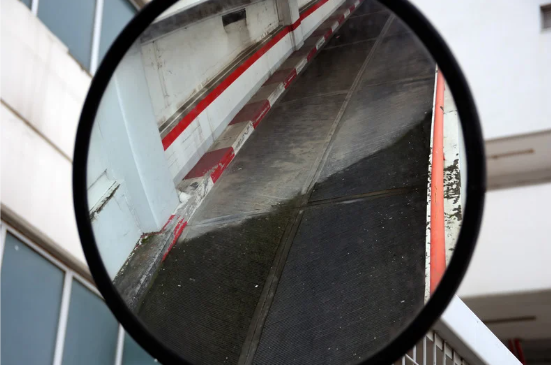
  • Used as rear-view mirrors in vehicles (gives wider field of view).
  • Used in security and surveillance mirrors.
  • Used in hallways and shops to monitor movement.

9. Quick Summary

PropertyConvex Mirror
TypeDiverging
Position of ImageBehind the mirror
NatureVirtual, erect
SizeDiminished
Sign of fPositive

Concave and Convex Mirrors Calculator

Click here for online calculator

Posted on Leave a comment

Isothermal Reversible Expansion worksheet

Problem Statement:

(i) Given:
5.2 mol of an ideal gas at 3 atm and 25 °C (298 K) expands isothermally to three times its original volume against an external pressure of 1 atm.
Find the work done (W) by the gas.

(ii) If the same gas expands isothermally and reversibly, determine the work done in that case.

Isothermal Expansion Work — Worked Example

Isothermal Expansion Work — Problem & Solution

Ideal gas at 25 °C (298 K)

Problem

  1. Given: 5.2 mol of an ideal gas at 3 atm and 25 °C expands isothermally to three times its original volume against a constant external pressure of 1 atm.
    Calculate the work done by the gas.
  2. If the same gas expands isothermally and reversibly, what is the work done?

Key Relations

Irreversible (constant external pressure):  \( w = -\,P_{\text{ext}}(V_2 – V_1) \)
Reversible isothermal (ideal gas):  \( w_{\text{rev}} = -\,nRT \ln\!\left(\dfrac{V_2}{V_1}\right) = -\,nRT \ln\!\left(\dfrac{P_1}{P_2}\right) \)
(or \( w_{\text{rev}} = -\,2.303\,nRT\,\log_{10}\!\left(\dfrac{V_2}{V_1}\right) \))

Use \(R=0.082\ \text{L·atm mol}^{-1}\text{K}^{-1}\) when working in L·atm, and \(1\ \text{L·atm}=101.325\ \text{J}\). Temperature \(T=298\ \text{K}\).

Solution (i) — Irreversible Expansion against 1 atm

Show steps

Initial volume from ideal gas law \(V_1=\dfrac{nRT}{P}\):

\( V_1=\dfrac{5.2\times 0.082\times 298}{3}=42.35\ \text{L} \)

Final volume: \( V_2 = 3V_1 = 3\times 42.35 = 127.05\ \text{L} \)

Work: \( w=-P_{\text{ext}}(V_2-V_1) = -1(127.05-42.35) = -84.7\ \text{L·atm} \)

Convert to joules: \( w = -84.7\times 101.325 = -8582.22\ \text{J} \)

Answer (i): \( \boxed{w=-8.58\ \text{kJ}} \) (negative for expansion)

Solution (ii) — Reversible Isothermal Expansion

Show steps

Volume ratio \( \dfrac{V_2}{V_1}=3 \Rightarrow \log_{10}(3)=0.4771 \)

\( w_{\text{rev}}=-\,2.303\times 5.2\times 8.314\times 298\times 0.4771 = -14156.38\ \text{J} \)

Answer (ii): \( \boxed{w_{\text{rev}}=-14.16\ \text{kJ}} \) (more work in magnitude; reversible path is maximum work)

Comparison

ProcessExpressionResult (J)Result (kJ)
Irreversible (1 atm ext.) \(w=-P_{\text{ext}}(V_2-V_1)\) \(-8582.22\) \(-8.58\)
Reversible isothermal \(w_{\text{rev}}=-nRT\ln(V_2/V_1)\) \(-14156.38\) \(-14.16\)

For a given \(T,n\), reversible expansion gives the largest magnitude of work.

Isothermal Reversible Expansion Work — Worksheet (with Hidden Solutions)

Isothermal Reversible Expansion Work — Theory & Worksheet

Ideal-gas, isothermal, reversible path. Hidden solutions included.

Topic: Thermodynamics Level: UG/Entrance/Industry QC Assumptions: Ideal gas, T constant

Quick Theory

For an ideal gas undergoing isothermal (T = const) reversible expansion/compression from \(V_1 \to V_2\):
\[ w = – \int_{V_1}^{V_2} P_{\text{ext}}\, dV = – \int_{V_1}^{V_2} \frac{nRT}{V}\, dV = -nRT \ln\!\left(\frac{V_2}{V_1}\right) \] Using \(PV=nRT\), the pressure form is \(\displaystyle w=-nRT\ln\!\left(\frac{P_1}{P_2}\right)\).
  • Sign convention (Chemistry): \(w < 0\) for expansion (system does work), \(w > 0\) for compression.
  • Units: Use \(R=8.314\ \text{J mol}^{-1}\text{K}^{-1}\) with \(T\) in K for \(w\) in J. Alternatively \(R=0.082057\ \text{L·atm mol}^{-1}\text{K}^{-1}\) and then convert \(1\ \text{L·atm} = 101.325\ \text{J}\).
  • Logs: Natural log only. If you must use \(\log_{10}\), then \(\ln x = 2.303 \log_{10}x\).
  • First Law note: For isothermal ideal gas, \(\Delta U=0\Rightarrow q=-w\).

Reversible path means \(P_\text{ext}\) differs infinitesimally from \(P_\text{gas}\), so \(P_\text{ext}=\frac{nRT}{V}\) along the path.

Worksheet — 10 Problems

Isothermal expansion, volumes given

\(n=1.00\ \text{mol},\ T=298.15\ \text{K},\ V_1=2.00\ \text{L},\ V_2=5.00\ \text{L}\). Find \(w\).

Show solution

\(\displaystyle \frac{V_2}{V_1}=2.500,\ \ln\!\left(\frac{V_2}{V_1}\right)=0.916291\)

\(\displaystyle w=-nRT\ln\!\left(\frac{V_2}{V_1}\right)=-1.00\times 8.314\times 298.15\times 0.916291=-2\,271\ \text{J}=-2.271\ \text{kJ}\) (expansion → \(w<0\))

Doubling volume at elevated temperature

\(n=0.50\ \text{mol},\ T=350.00\ \text{K},\ V_1=1.20\ \text{L},\ V_2=2.40\ \text{L}\). Find \(w\).

Show solution

\(\displaystyle \frac{V_2}{V_1}=2.000,\ \ln=0.693147\)

\(\displaystyle w=-0.50\times 8.314\times 350.00\times 0.693147=-1\,009\ \text{J}=-1.009\ \text{kJ}\)

Scaling with moles

\(n=2.00\ \text{mol},\ T=300.00\ \text{K},\ V_1=10.00\ \text{L},\ V_2=20.00\ \text{L}\). Find \(w\).

Show solution

\(\displaystyle \frac{V_2}{V_1}=2.000,\ \ln=0.693147\)

\(\displaystyle w=-2.00\times 8.314\times 300.00\times 0.693147=-3\,458\ \text{J}=-3.458\ \text{kJ}\)

Isothermal compression

\(n=1.50\ \text{mol},\ T=325.00\ \text{K},\ V_1=3.00\ \text{L},\ V_2=1.50\ \text{L}\). Find \(w\).

Show solution

\(\displaystyle \frac{V_2}{V_1}=0.500,\ \ln=-0.693147\)

\(\displaystyle w=-1.50\times 8.314\times 325.00\times (-0.693147)=+2\,810\ \text{J}=+2.810\ \text{kJ}\) (compression → \(w>0\))

Mild expansion at near-ambient temperature

\(n=0.75\ \text{mol},\ T=290.00\ \text{K},\ V_1=1.80\ \text{L},\ V_2=4.50\ \text{L}\). Find \(w\).

Show solution

\(\displaystyle \frac{V_2}{V_1}=2.500,\ \ln=0.916291\)

\(\displaystyle w=-0.75\times 8.314\times 290.00\times 0.916291=-1\,657\ \text{J}=-1.657\ \text{kJ}\)

Large expansion, higher T

\(n=3.00\ \text{mol},\ T=400.00\ \text{K},\ V_1=5.00\ \text{L},\ V_2=15.00\ \text{L}\). Find \(w\).

Show solution

\(\displaystyle \frac{V_2}{V_1}=3.000,\ \ln=1.098612\)

\(\displaystyle w=-3.00\times 8.314\times 400.00\times 1.098612=-10\,961\ \text{J}=-10.961\ \text{kJ}\)

Isothermal compression to half the volume

\(n=1.00\ \text{mol},\ T=298.15\ \text{K},\ V_1=1.00\ \text{L},\ V_2=0.50\ \text{L}\). Find \(w\).

Show solution

\(\displaystyle \frac{V_2}{V_1}=0.500,\ \ln=-0.693147\)

\(\displaystyle w=-1.00\times 8.314\times 298.15\times (-0.693147)=+1\,718\ \text{J}=+1.718\ \text{kJ}\)

Small sample expansion

\(n=0.25\ \text{mol},\ T=310.00\ \text{K},\ V_1=0.80\ \text{L},\ V_2=1.60\ \text{L}\). Find \(w\).

Show solution

\(\displaystyle \frac{V_2}{V_1}=2.000,\ \ln=0.693147\)

\(\displaystyle w=-0.25\times 8.314\times 310.00\times 0.693147=-447\ \text{J}=-0.447\ \text{kJ}\)

Compression at 0 °C

\(n=1.80\ \text{mol},\ T=273.15\ \text{K},\ V_1=12.00\ \text{L},\ V_2=6.00\ \text{L}\). Find \(w\).

Show solution

\(\displaystyle \frac{V_2}{V_1}=0.500,\ \ln=-0.693147\)

\(\displaystyle w=-1.80\times 8.314\times 273.15\times (-0.693147)=+2\,834\ \text{J}=+2.834\ \text{kJ}\)

Triple the volume at room temperature

\(n=0.60\ \text{mol},\ T=298.15\ \text{K},\ V_1=2.50\ \text{L},\ V_2=7.50\ \text{L}\). Find \(w\).

Show solution

\(\displaystyle \frac{V_2}{V_1}=3.000,\ \ln=1.098612\)

\(\displaystyle w=-0.60\times 8.314\times 298.15\times 1.098612=-1\,634\ \text{J}=-1.634\ \text{kJ}\)

Pressure-Form Practice (Tip)

If pressures are given instead of volumes, use \[ w = -nRT \ln\!\left(\frac{P_1}{P_2}\right) \] because for ideal gases \( \frac{V_2}{V_1} = \frac{P_1}{P_2} \) at constant \(T\) and \(n\).

Be sure pressure ratio is consistent with the physical change: expansion has \(P_2<P_1\) so \(\ln(P_1/P_2)>0\Rightarrow w<0\).

Self-Check

  • If \(V_2 > V_1\), your answer must be negative.
  • If \(V_2 < V_1\), your answer must be positive.
  • Magnitude grows with \(n\), \(T\), and \(|\ln(V_2/V_1)|\).

This worksheet assumes ideal-gas behavior and a perfectly reversible path. For real gases or finite-step external pressure changes, the integral and result differ.

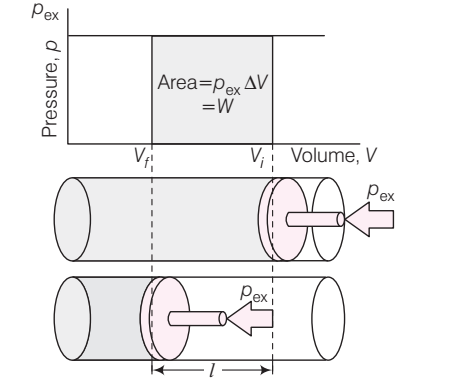
PV Plot

Posted on Leave a comment

Worksheet in Bubbles in Surface Tension

A drop of water of diameter 0.2 cm is broken up into 27,000 droplets of equal volumen. How much work will be done against surface tension in the process? (ST. = 7 x 10^-2 N/m)

Example Problem

SaitechAI Worksheet – Surface Tension Work (Droplet Splitting)

SaitechAI Worksheet

Topic: Work done against surface tension when a single drop splits into many droplets (Equal-volume droplets)
10 Questions × 2 marks = 20
Timer
Start:
End:
Duration:
  • Assume spherical drops. Volume conserved: \( n\frac{4}{3}\pi r^3=\frac{4}{3}\pi R^3 \Rightarrow r=\dfrac{R}{n^{1/3}}\).
  • Surface-area change: \( \Delta A = 4\pi R^2\left(n^{1/3}-1\right)\).
  • Work against surface tension: \( W=\sigma\,\Delta A \). Use SI units (R in m).
  • Show steps in the answer box. Toggle Key to verify.
Score: 0/20

Q1. A water drop of diameter 2 mm is broken into 1000 equal droplets. Surface tension = 0.072 N m−1. Find the work done.

Marks:
Key: \(R=1\times10^{-3}\,\text{m},\ n=10^3\Rightarrow n^{1/3}=10\). \(\Delta A=4\pi R^2(10-1)=36\pi\times10^{-6}\,\text{m}^2\). \(W=\sigma\Delta A=0.072\times36\pi\times10^{-6}\approx \boxed{8.143\times10^{-6}\,\text{J}}\).

Q2. A mercury drop of radius 0.8 cm is sprayed into \(10^5\) equal droplets. Surface tension = 0.465 N m−1. Energy required?

Marks:
Key: \(R=8.0\times10^{-3}\,\text{m},\ n^{1/3}\approx46.416\). \(\Delta A=4\pi R^2(n^{1/3}-1)\). \(W\approx \boxed{1.698\times10^{-2}\,\text{J}}\).

Q3. A water drop of radius 0.2 cm splits into 27,000 equal droplets. Surface tension = 0.070 N m−1. Compute the work.

Marks:
Key: \(R=2.0\times10^{-3}\,\text{m},\ n^{1/3}=30\). \(\Delta A=4\pi R^2(29)\). \(W=\sigma\Delta A\approx \boxed{1.020\times10^{-4}\,\text{J}}\).

Q4. A soap solution (σ = 0.025 N m−1) drop of diameter 1 cm is atomized into 8000 equal droplets. Work done?

Marks:
Key: \(R=5.0\times10^{-3}\,\text{m},\ n^{1/3}=20\). \(\Delta A=4\pi R^2(19)\). \(W\approx \boxed{1.492\times10^{-4}\,\text{J}}\).

Q5. A glycerine drop of radius 0.5 cm is broken into \(10^6\) equal droplets. σ = 0.063 N m−1. Energy?

Marks:
Key: \(R=5.0\times10^{-3}\,\text{m},\ n^{1/3}=100\). \(\Delta A=4\pi R^2(99)\). \(W\approx \boxed{1.959\times10^{-3}\,\text{J}}\).

Q6. A water drop of diameter 3 mm splits into 125 equal droplets. σ = 0.072 N m−1. Work done?

Marks:
Posted on Leave a comment

Concave and Convex Mirrors

Worksheet

Class 12 Physics – Ray Optics Worksheet (Mirrors)

Worksheet • Class 12 Physics (Ray Optics)

Topic: Ray Diagrams of Concave & Convex Mirrors • Focus: key terms, R–f relation, image formation
Subject: Physics Grade: 12 Questions: 12 Weightage: 2 marks each Time: ____ minutes Name: ____________________

Formula Box (use Cartesian sign convention)

  • Mirror formula: \(\dfrac{1}{f} = \dfrac{1}{v} + \dfrac{1}{u}\)
  • Magnification: \(m = -\dfrac{v}{u} = \dfrac{h_i}{h_o}\)
  • Radius–Focal relation: \(R = 2f\) (applies to both concave & convex mirrors; sign from convention)
  • Sign tips: For a concave mirror, \(f<0\). For a convex mirror, \(f>0\).

Drawing Hints (principal rays)

  • Ray parallel to principal axis → passes through F (concave) / appears from F (convex).
  • Ray through F → emerges parallel to axis.
  • Ray through C (centre of curvature) → retraces its path.
Q12 marks

Define the following key terms (1 mark each): (i) Pole (P) of a spherical mirror, (ii) Centre of curvature (C).

Q22 marks

State the relation between radius of curvature R and focal length f. A concave mirror has R = 60 cm. Using the sign convention, find f with sign.

Q32 marks

A convex mirror has R = 40 cm. Calculate its focal length and state its sign.

Q42 marks

Using a neat ray diagram, show image formation by a concave mirror when the object is placed beyond C. State the nature and approximate position of the image.

Draw the diagram here
Q52 marks

Draw the ray diagram for a concave mirror with the object at the principal focus F. What is the nature and location of the image?

Draw the diagram here
Q62 marks

For a concave mirror, draw the ray diagram when the object is placed between F and P. State the nature, orientation, and relative size of the image.

Draw the diagram here
Q72 marks

Using a ray diagram, show image formation in a convex mirror for an object placed in front of it. Mention the nature and typical location of the image.

Draw the diagram here
Q82 marks

Numerical (concave): A concave mirror has f = −15 cm. An object is placed at u = −30 cm. Find the image distance v and magnification m.

Q92 marks

Numerical (concave): A real image is formed at v = −24 cm when the object is at u = −36 cm. Determine the focal length f of the mirror (with sign).

Q102 marks

Numerical (convex): For a convex mirror, f = +20 cm and the object is at u = −40 cm. Find the image distance v and magnification m.

Q112 marks

Numerical (convex): A convex mirror produces an image that is half the size of the object. If the object is at u = −30 cm, find v and the focal length f.

Q122 marks

Numerical (concave): A concave mirror forms a real image that is 3 times the size of the object. If f = −10 cm, at what distance u from the mirror should the object be placed?

Note: Use the given sign convention consistently. Show essential steps for numerical answers. Diagrams must be labeled (P, C, F, principal axis).

Key

Answer for Worksheet

Posted on Leave a comment

Soap bubbles and Surface Tension

Interactive worksheet

SaitechAI | Coalescing Drops – Energy Release Worksheet & Calculator

SaitechAI Worksheet: Energy Released when Two Liquid Drops Coalesce

Interactive calculator + step-by-step derivation with MathJax. Units are SI by default.

Tip: inputs are in mm; calculator converts to meters automatically.
Show step-by-step solution

Theory (for any two spherical drops)

When two spherical drops of radii \(r_1\) and \(r_2\) coalesce to form a single spherical drop of radius \(R\), the total volume is conserved but the surface area decreases. The decrease in surface energy equals the energy released:

\[ \textbf{Volume conservation:}\quad \frac{4}{3}\pi R^3=\frac{4}{3}\pi\left(r_1^3+r_2^3\right)\Rightarrow R=\left(r_1^3+r_2^3\right)^{1/3} \] \[ \textbf{Surface areas:}\quad A_i=4\pi\left(r_1^2+r_2^2\right),\qquad A_f=4\pi R^2 \] \[ \textbf{Energy released:}\quad \Delta E=S\,(A_i-A_f)=4\pi S\left(r_1^2+r_2^2-R^2\right) \]

All radii must be in meters for \(\Delta E\) in joules.

Create More Practice

© SaitechAI

Posted on Leave a comment

Concave and Convex Mirrors

Worksheet

SaitechAI — Objective Questions (Focal Length & Radius, f = R/2)

SaitechAI — Objective Type Questions

Topic: Relation between focal length and radius of curvature, \( f=\dfrac{R}{2} \). Assume magnitudes (ignore sign convention unless asked); write units.

Questions

  1. A spherical mirror has \( R=40\cm \). Find \( f \).
  2. Given \( R=1.2\m \). Find \( f \).
  3. The focal length is \( f=15\cm \). Find \( R \).
  4. For \( R=80\cm \), compute \( f \).
  5. If \( f=0.75\m \), compute \( R \).
  6. For \( R=24\cm \), compute \( f \).
  7. Given \( f=25\cm \), compute \( R \).
  8. State the relation between \( f \) and \( R \) for a spherical mirror (paraxial).
  9. If radius of curvature doubles, how does focal length (magnitude) change?
  10. For \( R=100\cm \), compute \( f \).
  11. If \( f=2\m \), compute \( R \).
  12. For \( R=30\cm \), compute \( f \).

Answer Key

  1. \(20\cm\)
  2. \(0.6\m\)
  3. \(30\cm\)
  4. \(40\cm\)
  5. \(1.5\m\)
  6. \(12\cm\)
  7. \(50\cm\)
  8. \( f=\dfrac{R}{2} \) (equivalently \( R=2f \))
  9. It doubles.
  10. \(50\cm\)
  11. \(4\m\)
  12. \(15\cm\)

Tip: Always keep units consistent; convert \( \mathrm{cm} \leftrightarrow \mathrm{m} \) when needed.

© SaitechAI • Physics — Objective Questions
Posted on Leave a comment

Coalescence in liquid drops

Dr E. Ramanathan PhD | Class 11 Physics | Surface Tension

This problem is based on coalescience of liquid drops in the Surface Tension topic of Class 11 Physics.

Concept Explanation — Energy Released on Coalescence of Liquid Drops

When two small liquid drops merge (coalesce) to form a single larger drop, the total surface area decreases because the surface-to-volume ratio reduces. Since surface energy is directly proportional to surface area, this reduction leads to a release of surface energy in the form of heat or kinetic energy.

4. Interpretation

  • The merged drop has less total surface area.
  • The difference in surface energy (due to reduced surface area) appears as released energy.
  • Hence, energy released = decrease in surface area × surface tension.

Key Insight

Smaller drops have higher surface area per unit volume, meaning higher surface energy.
When they combine into a larger drop, the surface area reduces → surface energy decreasesenergy is released.

Interactive Worksheet – Click here

Posted on Leave a comment

Surface Tension

Video Lecture

Surface Tension

SaitechAI — Surface Tension (Class 11) Lecture Notes
SaitechAI

Surface Tension — Class 11 Lecture Notes

Physics (Properties of Fluids) · Rendered with MathJax

1) Concept & Molecular Picture

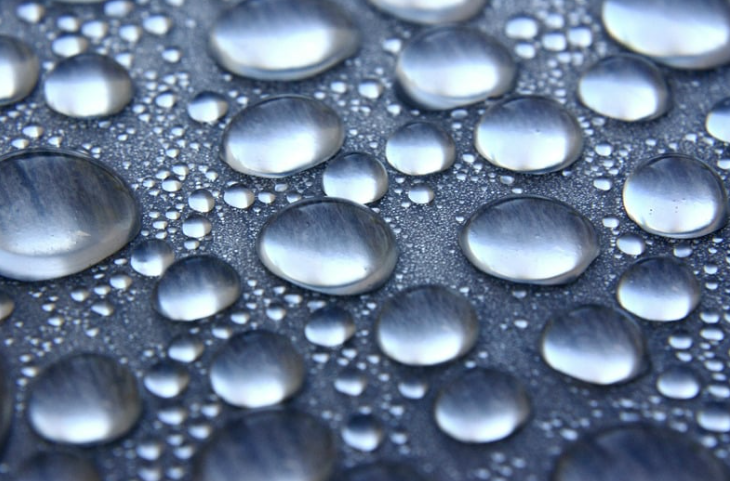
Idea: Molecules at the surface experience a net inward cohesive pull, making the surface behave like a stretched membrane.

  • Cohesion = attraction between molecules of the same liquid.
  • Adhesion = attraction between liquid and a different surface (e.g., glass).
  • Consequences: spherical droplets, meniscus formation, capillarity, soap bubbles, insects walking on water.

2) Definition & Units

Surface tension (also called surface force per unit length) is defined as

$$ T \equiv \frac{F}{L} $$

  • SI unit: \( \mathrm{N\,m^{-1}} \)
  • CGS unit: \( \mathrm{dyne\,cm^{-1}} \)

Surface energy: Work required to increase the surface area by unit amount. In SI, numerical value of surface energy per unit area equals \(T\) (J m\(^{-2}\) ↔ N m\(^{-1}\)).

3) Excess Pressure (Laplace law)

(a) Liquid drop (single interface)

For a spherical drop of radius \(r\):

$$ \Delta P = \frac{2T}{r} \quad \text{(inside higher than outside)} $$

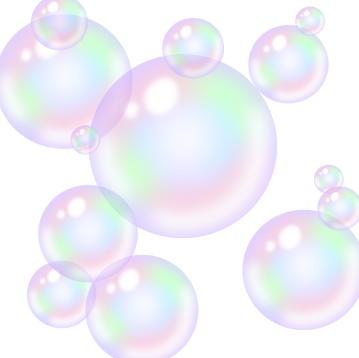
(b) Soap bubble (two interfaces)

For a spherical bubble of radius \(r\):

$$ \Delta P = \frac{4T}{r} $$

These follow from mechanical equilibrium of a curved surface under tension.

4) Capillarity & Angle of Contact

Capillary rise/fall in a tube of radius \(r\):

$$ h = \frac{2T\cos\theta}{\rho g r} $$

  • \(\theta\): angle of contact (acute for wetting liquids like water on glass → rise; obtuse for non-wetting like mercury on glass → fall).
  • \(\rho\): density of liquid, \(g\): acceleration due to gravity.

Meniscus: Concave when adhesion \(>\) cohesion (\(\theta<90^\circ\)); convex when cohesion \(>\) adhesion (\(\theta>90^\circ\)).

5) Temperature & Impurities

  • \(T\) decreases with temperature. Empirically: $$ T(T_{\text{abs}}) \approx T_0 \big(1 – k\,T_{\text{abs}}\big), \quad k>0. $$ \(T \to 0\) near the critical temperature.
  • Surface-active agents (soaps/detergents) reduce \(T\) and enhance wetting/cleaning.
  • Gas above liquid (air vs another immiscible liquid) also affects the measured \(T\).

6) Work & Energy at Surfaces

To create new area \( \Delta A \) at constant \(T\):

$$ W = T\,\Delta A, \qquad \text{so} \quad \frac{dW}{dA} = T. $$

Interpretation: \(T\) is the surface free energy per unit area (isothermal, reversible addition of area).

7) Typical Surface Tension Values (at ~20–25 °C)

LiquidApprox. \(T\) (N m\(^{-1}\))Remarks
Water0.072High; strong hydrogen bonding
Alcohol (ethanol)~0.022Lower than water
Glycerol~0.063Viscous, relatively high \(T\)
Mercury~0.485Very high; poor wetting on glass
Soap solution~0.025–0.040Reduced by surfactants

Values are indicative for classroom use; exact values depend on temperature and purity.

8) Illustrative Examples

Ex. 1 — Excess pressure in soap bubble

For a bubble of radius \( r = 1.0\,\text{mm} \) with \( T = 0.030\,\mathrm{N\,m^{-1}} \):

$$ \Delta P = \frac{4T}{r} = \frac{4\times 0.030}{1.0\times 10^{-3}} = 120\,\text{Pa}. $$

Ex. 2 — Capillary rise of water

\( r = 0.50\,\text{mm},\; T = 0.072\,\mathrm{N\,m^{-1}},\; \rho = 1000\,\mathrm{kg\,m^{-3}},\; \theta \approx 0^\circ \):

$$ h = \frac{2T\cos\theta}{\rho g r} = \frac{2 \times 0.072 \times 1}{1000 \times 9.8 \times 0.5\times 10^{-3}} \approx 0.029\,\text{m} \;=\; 2.9\,\text{cm}. $$

9) Quick Checks

  1. State the SI unit of surface tension and surface energy per unit area.
    Ans: Both numerically \( \mathrm{N\,m^{-1}} \) (and \( \mathrm{J\,m^{-2}} \) for surface energy).
  2. Why does mercury form a convex meniscus in glass?
    Ans: Cohesion \( \gt \) adhesion ⇒ \( \theta > 90^\circ \).
  3. Show that \( h \propto \dfrac{1}{r} \) for a wetting liquid in a capillary.
    Ans: From \( h=\dfrac{2T\cos\theta}{\rho g r} \) with \(T,\theta,\rho,g\) fixed.

10) Common Applications

  • Cleaning action of soaps/detergents (reduced \(T\) improves wetting).
  • Capillary action in plant xylem; wicks in lamps and pens.
  • Drop formation, emulsions/foams stabilization with surfactants.
  • Coating & printing processes (wetting, spread, leveling depend on \(T\) and \(\theta\)).
Formula Sheet (at a glance)
  • \( T = \dfrac{F}{L} \)
  • \( \Delta P_{\text{drop}} = \dfrac{2T}{r} \), \(\;\Delta P_{\text{bubble}} = \dfrac{4T}{r} \)
  • \( h = \dfrac{2T\cos\theta}{\rho g r} \)
  • \( W = T\,\Delta A \)

© SaitechAI — Prepared for Class 11 learners. You may print or save this page for study use.

Capillarity

Lecture Notes

Worksheet in Surface Tension, Surface Energy, Capillarity, contact angle, pressure inside the soap bubble.

Worksheet set-2

Worksheet set-3

Question
Question Image Question Image
SaitechAI

Doubt Clinic Worksheets

Question Number 6 in worksheet set-2

Posted on Leave a comment

Dynamic Modern Periodic Table

Modern Periodic Table — Lecture Notes (Class 11, SaitechAI Edition)


1. Historical Development

  • Dobereiner’s Triads (1829): Elements were grouped in triads with similar properties. The atomic mass of the middle element was approximately the mean of the other two.
    Example: Li (7), Na (23), K (39).
  • Newlands’ Law of Octaves (1865): Every eighth element showed similar properties when arranged by increasing atomic mass.
  • Mendeleev’s Periodic Law (1869): The properties of elements are periodic functions of their atomic masses.
    Limitations: Position of isotopes, anomalous pairs (Co–Ni, Te–I).
  • Modern Periodic Law (Moseley, 1913): “The physical and chemical properties of elements are periodic functions of their atomic numbers.”

2. Structure of the Modern Periodic Table

  • Basis: Atomic number (Z)
  • Total elements: 118 (known till 2025)
  • Periods: 7 horizontal rows (number of energy shells)
  • Groups: 18 vertical columns (number of valence electrons)
  • Block classification:
    • s-block: Groups 1 & 2
    • p-block: Groups 13–18
    • d-block: Transition elements (Groups 3–12)
    • f-block: Inner transition elements (Lanthanides & Actinides)

3. Features of Periods and Groups

FeaturePeriodsGroups
Number718
RepresentsPrincipal quantum number (n)Valence shell configuration
Example2nd period → Li to NeGroup 17 → Halogens (F, Cl, Br, I, At)

4. Important Trends in the Periodic Table

(a) Atomic Radius

  • ↓ Group → increases (new shells added)
  • → Period → decreases (nuclear charge ↑)

(b) Ionization Enthalpy (IE)

  • ↓ Group → decreases (outer electrons farther)
  • → Period → increases (nuclear charge ↑)

(c) Electron Gain Enthalpy (EGE)

  • → Period → generally becomes more negative
  • ↓ Group → becomes less negative
  • Exception: Noble gases have positive EGE.

(d) Electronegativity

  • → Period → increases
  • ↓ Group → decreases
  • Pauling scale: F = 4.0 (highest)

(e) Metallic and Nonmetallic Character

  • Metallic character ↓ across a period, ↑ down a group.
  • Nonmetallic character shows reverse trend.

(f) Valency

  • Depends on group number:
    • Group 1 → valency 1
    • Group 14 → valency 4
    • Group 17 → valency 1
    • Group 18 → valency 0

5. Anomalies and Exceptions

  • Diagonal relationship: Li–Mg, Be–Al (similar properties)
  • d-Block contraction: due to poor shielding of d-electrons.
  • Lanthanide contraction: causes Zr–Hf similarity.

6. Applications

  • Predicting properties of elements.
  • Classifying unknown elements.
  • Understanding chemical reactivity.
  • Basis for electronic configuration and chemical bonding.

7. Modern Periodic Table Snapshot

BlockRangeExample ElementsCharacteristic
s-block1–2Na, MgHighly reactive metals
p-block13–18B, C, N, O, FIncludes nonmetals, metalloids
d-block3–12Fe, Cu, ZnTransition metals
f-blockLanthanoids, ActinoidsCe, UInner transition metals

8. Mathematical Expression

where ( Z ) = atomic number, ( p ) = number of protons, ( n ) = neutrons.


9. Quick Revision Points

  • Elements arranged by atomic number.
  • Periodicity due to repetition of similar electronic configuration.
  • Noble gases show complete outer shells → inert nature.
  • Across a period: metallic → nonmetallic transition.
  • Down a group: atomic size ↑, ionization energy ↓.

SaitechAI • Dynamic Modern Periodic Table (Crosshair + Auto Details)
SaitechAI
Dynamic Periodic Table • Draggable Crosshair
Posted on Leave a comment

Logarithm Concept Drone

Logarithm & Antilogarithm — Definitions, Rules, Examples | SaitechAI
SaitechAI
MathJax Enabled

Logarithm & Antilogarithm — Terms, Rules, and Examples

All math on this page renders via MathJax. Use Ctrl/Cmd + P to print or save as PDF.

Core Definitions

  • Logarithm: If \(b^x=N\) with \(b>0,\; b\neq 1,\; N>0\), then \[ \log_b(N)=x. \] It is “the power to which the base \(b\) must be raised to obtain \(N\)”.
  • Common logarithm: Base \(10\): \(\log_{10}N\) or \(\log N\).
  • Natural logarithm: Base \(e\;( \approx 2.71828)\): \(\ln N=\log_e N\).
  • Characteristic & Mantissa (base 10): For \(\log_{10}N\), the characteristic is the integer part and the mantissa is the fractional part.
    Example ( \(N>1\) ): \[ \log_{10}(250)=2.3979 \quad\Rightarrow\quad \text{Characteristic}=2,\;\text{Mantissa}=0.3979. \]
    Example ( \(0<N<1\) ): \[ \log_{10}(0.0045) = -3 + 0.6532 \;=\; \overline{3}.6532, \] where the bar on \(3\) denotes a negative characteristic with positive mantissa.
  • Antilogarithm: The inverse of a logarithm. If \(x=\log_b(N)\) then \[ \operatorname{antilog}_b(x)=N=b^x. \]

Fundamental Rules of Logarithms

1) Product Rule

\[ \log_b(MN)=\log_b M + \log_b N \]

Log of a product equals the sum of logs.

2) Quotient Rule

\[ \log_b\!\left(\frac{M}{N}\right)=\log_b M – \log_b N \]

Log of a quotient equals the difference of logs.

3) Power Rule

\[ \log_b(M^k)=k\,\log_b M \]

Exponent becomes a multiplier.

4) Root Rule

\[ \log_b\!\big(\sqrt[n]{M}\big)=\frac{1}{n}\,\log_b M \]

An \(n\)-th root is a power of \(\tfrac{1}{n}\).

5) Log of 1 & Base

\[ \log_b(1)=0,\qquad \log_b(b)=1. \]

6) Change of Base

\[ \log_b(M)=\frac{\log_k(M)}{\log_k(b)} \quad (\text{often } k=10 \text{ or } e). \]

Domains: \(b>0,\; b\neq 1,\; M>0,\; N>0\).

Worked Examples

A. Using Product, Quotient, and Power Rules

Example A1: \(\log_{10}(2000)\)

\[ \log_{10}(2\times 10^3)=\log_{10}2 + \log_{10}(10^3) = \log_{10}2 + 3 \approx 0.3010 + 3 = 3.3010. \]

Example A2: \(\log_{10}\!\left(\dfrac{50}{2}\right)\)

\[ \log_{10}50 – \log_{10}2 \approx 1.6990 – 0.3010 = 1.3980. \]

Example A3: \(\log_2(32)\)

\[ \log_2(2^5) = 5\,\log_2 2 = 5. \]

Example A4: \(\log_{10}\!\big(\sqrt[3]{1000}\big)\)

\[ \frac{1}{3}\log_{10}(1000)=\frac{1}{3}\cdot 3=1. \]

B. Change of Base

\[ \log_{3}(20)=\frac{\ln(20)}{\ln(3)} \approx \frac{2.9957}{1.0986}\approx 2.728. \]

C. Antilogarithms (Base 10)

Example C1: If \(\log_{10}(N)=2.3010\), then \[ N = \operatorname{antilog}_{10}(2.3010)=10^{2.3010}\approx 200. \]

Example C2: If \(\log_{10}(N)=\overline{1}.4771\) (i.e., \(-1+0.4771\)), then \[ N = 10^{-1+0.4771}=10^{-1}\cdot 10^{0.4771}\approx 0.1\times 3=0.3. \]

Quick Reference

Quantity Formula / Value Note
Definition \(b^x=N \iff \log_b N = x\) \(b>0,\; b\neq 1,\; N>0\)
Product \(\log_b(MN)=\log_b M+\log_b N\) Sum of logs
Quotient \(\log_b\!\left(\dfrac{M}{N}\right)=\log_b M-\log_b N\) Difference of logs
Power \(\log_b(M^k)=k\,\log_b M\) Exponent to multiplier
Root \(\log_b(\sqrt[n]{M})=\tfrac{1}{n}\log_b M\) \(n\in\mathbb{N}\)
Change of Base \(\log_b M=\dfrac{\log_k M}{\log_k b}\) Use \(k=10\) or \(k=e\)
Antilog \(\operatorname{antilog}_b(x)=b^x\) Inverse of \(\log_b\)
© SaitechAI

Interactive Logarithm Calculator

Applications of Logarithms with examples

Interactive Logarithm and Antilogarithm Table with Draggable Crosshair

Logarithm Applications

Posted on Leave a comment

Concentration Expressions CD

Developed by Dr E. Ramanathan

Target Audience: High School, Higher Secondary Students, NEET-JEE Aspirants, Chemists, Engineers, Operators from Surface Coating Technology Field.

Terms, Definitions, Symbols – TDS

SaitechAI — Concentration Terms & Definitions

Concentration Terms and Definitions — SaitechAI

Term Definition / Formula Units
Weight/Weight % (w/w%) \(\%w/w = \dfrac{w_2}{W}\times 100\) % (g solute per 100 g solution)
Weight/Volume % (w/v%) \(\%w/v = \dfrac{w_2}{V}\times 100\) % (g solute per 100 mL solution)
Volume/Volume % (v/v%) \(\%v/v = \dfrac{V_2}{V}\times 100\) % (mL solute per 100 mL solution)
Molarity (M) \(M = \dfrac{n_2}{V} = \dfrac{w_2}{M_2 \cdot V}\) mol·L⁻¹
Molality (m) \(m = \dfrac{n_2}{w_1(\mathrm{kg})} = \dfrac{w_2}{M_2 \cdot w_1(\mathrm{kg})}\) mol·kg⁻¹
Normality (N) \(N = \dfrac{eq_2}{V} = \dfrac{w_2}{\text{GEW}_2 \cdot V}, \ \text{GEW}_2 = \dfrac{M_2}{e}\) eq·L⁻¹
Mole Fraction (\(x_2\)) \(x_2 = \dfrac{n_2}{n_1+n_2}\) Dimensionless
Parts per million (ppm) \(\text{ppm} = \dfrac{w_2}{W}\times 10^6\)
For aqueous solutions: \(1 \ \text{mg·L}^{-1} \approx 1 \ \text{ppm}\)
ppm (mg·L⁻¹)

Symbols: \(w_2\) = solute mass (g), \(w_1\) = solvent mass (g or kg), \(W = w_1+w_2\) = solution mass, \(V\) = solution volume (L), \(V_2\) = solute volume, \(M_2\) = molar mass of solute (g·mol⁻¹), \(e\) = equivalence factor.

© 2025 SaitechAI. All rights reserved.

Data, Equations, Formulations

SaitechAI — Expressions of Concentration

Expressions of Concentration — SaitechAI

Symbols & Definitions

  • \(w_2\): mass (weight) of solute; \(w_1\): mass of solvent; \(W=w_1+w_2\): mass of solution.
  • \(M_2\): molar mass of solute; \(M_1\): molar mass of solvent.
  • \(n_2=\dfrac{w_2}{M_2}\): moles of solute; \(\;n_1=\dfrac{w_1}{M_1}\): moles of solvent.
  • \(V_2\): volume of liquid solute; \(V_1\): volume of solvent; \(V\): volume of solution.

Unless stated otherwise: masses in grams, volumes in litres (L) for molarity, and kilograms (kg) for molality denominator.

Percent Concentrations

  • w/w %: \(\displaystyle \%\,\frac{w}{w}=\frac{w_2}{W}\times 100\)
  • w/v %: \(\displaystyle \%\,\frac{w}{v}=\frac{w_2}{V}\times 100\)
  • v/v %: \(\displaystyle \%\,\frac{v}{v}=\frac{V_2}{V}\times 100\)

Molarity (\(M\))

\[ M \;=\; \frac{n_2}{V}\;=\;\frac{w_2/M_2}{V}\quad\text{(mol L}^{-1}\text{)} \]

Normality (\(N\))

\[ N \;=\; \frac{\text{equivalents of solute}}{V} \;=\; \frac{eq_2}{V},\qquad eq_2 \;=\; \frac{w_2}{\text{GEW}_2} \]

\[ \text{GEW}_2 \;=\; \frac{M_2}{e} \] where \(e\) is the valence (equivalence) factor determined by the reaction context (acid–base, redox, precipitation, etc.).

Solute (typical context)\(e\)Notes
\(\mathrm{HCl}\), \(\mathrm{NaOH}\) (acid–base)1Monoprotic acid / monobasic base
\(\mathrm{H_2SO_4}\) (acid–base)2Diprotic acid (can donate 2 H\(^+\))
\(\mathrm{CaSO_4}\) (precipitation/ionic)2In ionic reactions, \(e\) equals total charge change per mole participating

Molality (\(m\))

Defined per kilogram of solvent (not solution).

\[ m \;=\; \frac{n_2}{\;w_1\;(\mathrm{kg})}\;=\;\frac{w_2/M_2}{w_1(\mathrm{kg})}\quad\text{(mol kg}^{-1}\text{)} \]

Mole Fraction

Sum of all mole fractions equals 1.

\[ x_2 \;=\; \frac{n_2}{n_1+n_2},\qquad x_1 \;=\; \frac{n_1}{n_1+n_2},\qquad x_1+x_2=1 \]

Parts Per Million (ppm)

  • Mass fraction (general): \[ \mathrm{ppm} \;=\; \frac{w_2}{W}\times 10^{6} \]
  • Aqueous, dilute (practical): \[ \mathrm{ppm} \;\approx\; \frac{\text{mg solute}}{\text{L solution}} \] (since \(1~\mathrm{mg\,L^{-1}}\approx 1~\mathrm{ppm}\) for water-like density)
  • Volume basis (less common): if using \(w/v\) fraction, \[ \mathrm{ppm} \;=\; \bigl(\tfrac{w}{v}\bigr)\times 10^{6} \] with consistent units.

Quick Reference

QuantityPrimary FormulaCommon Rearrangement
Molarity, \(M\) \(M=\dfrac{n_2}{V}\) \(M=\dfrac{w_2}{M_2\,V}\)
Normality, \(N\) \(N=\dfrac{eq_2}{V}\) \(N=\dfrac{w_2}{\text{GEW}_2\,V}\)
Molality, \(m\) \(m=\dfrac{n_2}{w_1(\mathrm{kg})}\) \(m=\dfrac{w_2}{M_2\,w_1(\mathrm{kg})}\)
Mole fraction, \(x_2\) \(x_2=\dfrac{n_2}{n_1+n_2}\) \(x_1=\dfrac{n_1}{n_1+n_2}\)
w/w% \(\dfrac{w_2}{W}\times 100\)
w/v% \(\dfrac{w_2}{V}\times 100\)
v/v% \(\dfrac{V_2}{V}\times 100\)
ppm (mass) \(\dfrac{w_2}{W}\times 10^{6}\) \(\approx\dfrac{\text{mg}}{\text{L}}\) (aqueous)

Always specify temperature and density assumptions when converting between mass- and volume-based measures.

© 2025 SaitechAI. All formulae rendered with MathJax.

Concept Map

Different Expressions of Concentration Term

Video Lecture in English/Tamil

Deployment

Concentration Calculator