A concave mirror is a part of a sphere with reflecting surface on the inner side. Parallel rays near the principal axis converge to the focal point , lying at a distance from the pole . Center of curvature is with radius .
Mirror formula • Cartesian sign convention • Magnification • Practice problems (solutions hidden)
Concept
Concave (Converging) Spherical Mirror
A concave mirror is a part of a sphere with reflecting surface on the inner side. Parallel rays near the principal axis converge to the focal point \(F\), lying at a distance \(f\) from the pole \(P\). Center of curvature is \(C\) with radius \(R\).
Focal length: \( f = \dfrac{R}{2} \)
Magnification: \( m = \dfrac{h_i}{h_o} = \dfrac{v}{u} \)
Image nature: Depends on object position (beyond \(C\), at \(C\), between \(C\) and \(F\), at \(F\), between \(F\) and \(P\)).
Linear magnification: \(m=\dfrac{v}{u}\). For real inverted images, \(m<0\); for virtual erect images, \(m>0\).
Convention
Cartesian Sign Convention
Principal axis is the positive x-axis to the right; pole \(P\) at origin.
Distances measured towards the light (incident side, left of mirror) are negative.
Distances measured to the right of the mirror are positive.
For concave mirror: \(f\) and \(R\) are negative.
Heights above axis positive; below axis negative.
How to Solve
Quick Procedure
Assign signs to \( (u, v, f) \) using the convention.
Apply \( \left( \frac{1}{f} = \frac{1}{v} + \frac{1}{u} \right) \) to find the unknown distance(s).
Use \( \left( m = \frac{v}{u} = \frac{h_i}{h_o} \right) \) for size relation, if needed.
Conclude nature: real/virtual (sign of \( v \)), erect/inverted (sign of \( m \)).
Worksheet
Practice Problems (NCERT/AI – adapted)
6) An object is placed before a concave mirror of focal length 15 cm. The image is three times the size of the object. Find the two possible object distances from the mirror.
\(m = \frac{v}{u} = -3\) or \(+3\). Mirror formula \( \frac{1}{f} = \frac{1}{v} + \frac{1}{u}\), \(f = -15\).
For \(m = -3\): \(u = \frac{(1+m)}{m}f = \frac{(1-3)}{-3}(-15) = -10\) cm, \(v = mu = -30\) cm.
For \(m = +3\): \(u = \frac{(1+m)}{m}f = \frac{4}{3}(-15) = -20\) cm, \(v = +60\) cm.
Hence possible object distances: **10 cm and 20 cm** in front of mirror.
7) A convex rear-view mirror of radius 2 m shows a jogger approaching at 5 m/s. Find the speed of the image when the jogger is at (a) 39 m (b) 29 m.
8) A mobile phone along the principal axis of a concave mirror forms distorted images. Explain why magnification is non-uniform.
Each point on the phone lies at different \(u_i\). Since \(1/f=1/v_i+1/u_i\), each part forms at different \(v_i\). So \(m_i = v_i/u_i\) varies along the length → non-uniform magnification → distortion.
9) Find object distance from a concave mirror (R = 20 cm) for a real image of magnification 2.
\(f = -10\) cm, \(m = -2\). \(v = mu = -2u\). \(1/f = 1/v + 1/u = 1/(-2u)+1/u = 1/(2u)\Rightarrow u=-5\) cm, \(v=-10\) cm. Hence image real and magnified.
10) Derive the mirror formula using a ray diagram for a concave mirror forming a real magnified image.
Using geometry of similar triangles \( \triangle A’B’F \sim \triangle ABF \): \( \frac{AB}{A’B’} = \frac{BF}{B’F} \Rightarrow \frac{1}{f}=\frac{1}{v}+\frac{1}{u}\).
11) (a) Draw ray diagram for real, inverted, magnified image by concave mirror. (b) Write mirror formula and magnification.
(a) Object between \(C\) and \(F\) → image beyond \(C\), inverted and magnified.
(b) \( \frac{1}{f}=\frac{1}{v}+\frac{1}{u},\quad m=\frac{h_i}{h_o}=\frac{v}{u}. \)
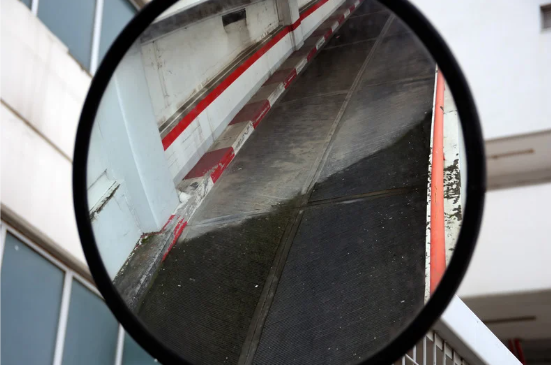
A convex mirror is a spherical mirror whose reflecting surface is bulged outward. It diverges the rays of light that fall on it and hence it is also called a diverging mirror.
2. Focal Length and Radius of Curvature
Centre of curvature \( C \) lies behind the mirror.
Focal point \( F \) also lies behind the mirror.
For convex mirror, both \( f \) and \( R \) are taken as positive according to the Cartesian sign convention.
Relationship: \( f = \dfrac{R}{2} \)
3. Mirror Formula
The same mirror equation applies:
\[
\frac{1}{f} = \frac{1}{v} + \frac{1}{u}
\]
where \( f \) = focal length, \( u \) = object distance, \( v \) = image distance.
4. Sign Convention (Cartesian)
Distances measured opposite to the direction of incident light are negative.
Distances measured along the direction of incident light are positive.
For a convex mirror: \( f > 0 \), \( R > 0 \), \( u < 0 \), \( v > 0 \).
5. Image Characteristics
When an object is placed anywhere in front of a convex mirror:
The image is always virtual (formed behind the mirror).
It is erect and diminished.
The image always lies between \( F \) and the pole \( P \).
6. Ray Diagram Explanation
Ray parallel to principal axis → appears to diverge from the focus \( F \).
Ray directed towards centre of curvature \( C \) → reflected back along the same path (appears to meet at \( C \)).
The intersection (virtual) of reflected rays gives the image position behind the mirror.
7. Magnification
Linear magnification \( m \) is given by:
\[
m = \frac{h_i}{h_o} = \frac{v}{u}
\]
For convex mirror, \( v \) is positive and \( u \) negative, hence \( m \) is positive and less than 1, implying an erect and diminished image.
8. Uses
Used as rear-view mirrors in vehicles (gives wider field of view).