Concept
A concave mirror is a part of a sphere with reflecting surface on the inner side. Parallel rays near the principal axis converge to the focal point , lying at a distance from the pole . Center of curvature is with radius .
Worksheet
Concave Mirror – Concept & Application Worksheet
Mirror formula • Cartesian sign convention • Magnification • Practice problems (solutions hidden)
Concave (Converging) Spherical Mirror
A concave mirror is a part of a sphere with reflecting surface on the inner side. Parallel rays near the principal axis converge to the focal point \(F\), lying at a distance \(f\) from the pole \(P\). Center of curvature is \(C\) with radius \(R\).
- Focal length: \( f = \dfrac{R}{2} \)
- Magnification: \( m = \dfrac{h_i}{h_o} = \dfrac{v}{u} \)
- Image nature: Depends on object position (beyond \(C\), at \(C\), between \(C\) and \(F\), at \(F\), between \(F\) and \(P\)).
Mirror Formula
For paraxial rays (small aperture), object distance \(u\), image distance \(v\), focal length \(f\):
\(\displaystyle \frac{1}{f}=\frac{1}{v}+\frac{1}{u}\)
Linear magnification: \(m=\dfrac{v}{u}\). For real inverted images, \(m<0\); for virtual erect images, \(m>0\).
Cartesian Sign Convention
- Principal axis is the positive x-axis to the right; pole \(P\) at origin.
- Distances measured towards the light (incident side, left of mirror) are negative.
- Distances measured to the right of the mirror are positive.
- For concave mirror: \(f\) and \(R\) are negative.
- Heights above axis positive; below axis negative.
Quick Procedure
- Assign signs to \( (u, v, f) \) using the convention.
- Apply \( \left( \frac{1}{f} = \frac{1}{v} + \frac{1}{u} \right) \) to find the unknown distance(s).
- Use \( \left( m = \frac{v}{u} = \frac{h_i}{h_o} \right) \) for size relation, if needed.
- Conclude nature: real/virtual (sign of \( v \)), erect/inverted (sign of \( m \)).
Practice Problems (NCERT/AI – adapted)
6) An object is placed before a concave mirror of focal length 15 cm. The image is three times the size of the object. Find the two possible object distances from the mirror.
For \(m = -3\): \(u = \frac{(1+m)}{m}f = \frac{(1-3)}{-3}(-15) = -10\) cm, \(v = mu = -30\) cm.
For \(m = +3\): \(u = \frac{(1+m)}{m}f = \frac{4}{3}(-15) = -20\) cm, \(v = +60\) cm.
Hence possible object distances: **10 cm and 20 cm** in front of mirror.
7) A convex rear-view mirror of radius 2 m shows a jogger approaching at 5 m/s. Find the speed of the image when the jogger is at (a) 39 m (b) 29 m.
(a) \(x=39 \Rightarrow |dv/dt| = \frac{5}{40^2}=3.1\text{ mm/s}\); (b) \(x=29 \Rightarrow 5.6\text{ mm/s}\).
8) A mobile phone along the principal axis of a concave mirror forms distorted images. Explain why magnification is non-uniform.
9) Find object distance from a concave mirror (R = 20 cm) for a real image of magnification 2.
10) Derive the mirror formula using a ray diagram for a concave mirror forming a real magnified image.
11) (a) Draw ray diagram for real, inverted, magnified image by concave mirror. (b) Write mirror formula and magnification.
(b) \( \frac{1}{f}=\frac{1}{v}+\frac{1}{u},\quad m=\frac{h_i}{h_o}=\frac{v}{u}. \)

Convex Mirror – Concept and Key Points
1. Definition
A convex mirror is a spherical mirror whose reflecting surface is bulged outward. It diverges the rays of light that fall on it and hence it is also called a diverging mirror.
2. Focal Length and Radius of Curvature
- Centre of curvature \( C \) lies behind the mirror.
- Focal point \( F \) also lies behind the mirror.
- For convex mirror, both \( f \) and \( R \) are taken as positive according to the Cartesian sign convention.
- Relationship: \( f = \dfrac{R}{2} \)
3. Mirror Formula
The same mirror equation applies: \[ \frac{1}{f} = \frac{1}{v} + \frac{1}{u} \] where \( f \) = focal length, \( u \) = object distance, \( v \) = image distance.
4. Sign Convention (Cartesian)
- Distances measured opposite to the direction of incident light are negative.
- Distances measured along the direction of incident light are positive.
- For a convex mirror: \( f > 0 \), \( R > 0 \), \( u < 0 \), \( v > 0 \).
5. Image Characteristics
When an object is placed anywhere in front of a convex mirror:
- The image is always virtual (formed behind the mirror).
- It is erect and diminished.
- The image always lies between \( F \) and the pole \( P \).
6. Ray Diagram Explanation
- Ray parallel to principal axis → appears to diverge from the focus \( F \).
- Ray directed towards centre of curvature \( C \) → reflected back along the same path (appears to meet at \( C \)).
- The intersection (virtual) of reflected rays gives the image position behind the mirror.
7. Magnification
Linear magnification \( m \) is given by: \[ m = \frac{h_i}{h_o} = \frac{v}{u} \] For convex mirror, \( v \) is positive and \( u \) negative, hence \( m \) is positive and less than 1, implying an erect and diminished image.
8. Uses
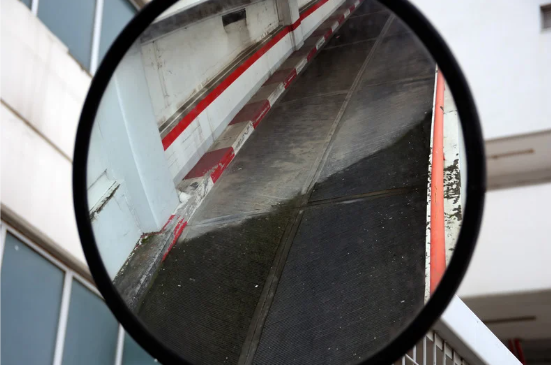
- Used as rear-view mirrors in vehicles (gives wider field of view).
- Used in security and surveillance mirrors.
- Used in hallways and shops to monitor movement.
9. Quick Summary
| Property | Convex Mirror |
|---|---|
| Type | Diverging |
| Position of Image | Behind the mirror |
| Nature | Virtual, erect |
| Size | Diminished |
| Sign of f | Positive |