Problem Statement:
(i) Given:
5.2 mol of an ideal gas at 3 atm and 25 °C (298 K) expands isothermally to three times its original volume against an external pressure of 1 atm.
Find the work done (W) by the gas.
(ii) If the same gas expands isothermally and reversibly, determine the work done in that case.
Isothermal Expansion Work — Problem & Solution
Ideal gas at 25 °C (298 K)
Problem
-
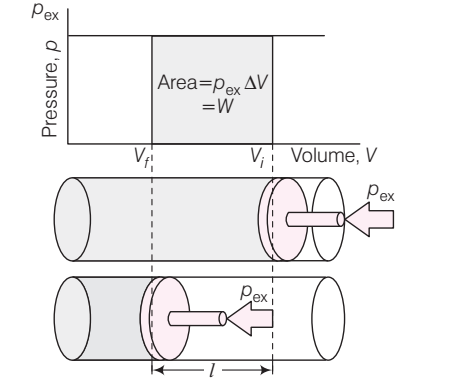
Given: 5.2 mol of an ideal gas at 3 atm and 25 °C expands isothermally to
three times its original volume against a constant external pressure of 1 atm.
Calculate the work done by the gas. - If the same gas expands isothermally and reversibly, what is the work done?
Key Relations
Reversible isothermal (ideal gas): \( w_{\text{rev}} = -\,nRT \ln\!\left(\dfrac{V_2}{V_1}\right) = -\,nRT \ln\!\left(\dfrac{P_1}{P_2}\right) \)
(or \( w_{\text{rev}} = -\,2.303\,nRT\,\log_{10}\!\left(\dfrac{V_2}{V_1}\right) \))
Use \(R=0.082\ \text{L·atm mol}^{-1}\text{K}^{-1}\) when working in L·atm, and \(1\ \text{L·atm}=101.325\ \text{J}\). Temperature \(T=298\ \text{K}\).
Solution (i) — Irreversible Expansion against 1 atm
Show steps
Initial volume from ideal gas law \(V_1=\dfrac{nRT}{P}\):
\( V_1=\dfrac{5.2\times 0.082\times 298}{3}=42.35\ \text{L} \)
Final volume: \( V_2 = 3V_1 = 3\times 42.35 = 127.05\ \text{L} \)
Work: \( w=-P_{\text{ext}}(V_2-V_1) = -1(127.05-42.35) = -84.7\ \text{L·atm} \)
Convert to joules: \( w = -84.7\times 101.325 = -8582.22\ \text{J} \)
Answer (i): \( \boxed{w=-8.58\ \text{kJ}} \) (negative for expansion)
Solution (ii) — Reversible Isothermal Expansion
Show steps
Volume ratio \( \dfrac{V_2}{V_1}=3 \Rightarrow \log_{10}(3)=0.4771 \)
\( w_{\text{rev}}=-\,2.303\times 5.2\times 8.314\times 298\times 0.4771 = -14156.38\ \text{J} \)
Answer (ii): \( \boxed{w_{\text{rev}}=-14.16\ \text{kJ}} \) (more work in magnitude; reversible path is maximum work)
Comparison
| Process | Expression | Result (J) | Result (kJ) |
|---|---|---|---|
| Irreversible (1 atm ext.) | \(w=-P_{\text{ext}}(V_2-V_1)\) | \(-8582.22\) | \(-8.58\) |
| Reversible isothermal | \(w_{\text{rev}}=-nRT\ln(V_2/V_1)\) | \(-14156.38\) | \(-14.16\) |
For a given \(T,n\), reversible expansion gives the largest magnitude of work.
Isothermal Reversible Expansion Work — Theory & Worksheet
Ideal-gas, isothermal, reversible path. Hidden solutions included.
Quick Theory
\[ w = – \int_{V_1}^{V_2} P_{\text{ext}}\, dV = – \int_{V_1}^{V_2} \frac{nRT}{V}\, dV = -nRT \ln\!\left(\frac{V_2}{V_1}\right) \] Using \(PV=nRT\), the pressure form is \(\displaystyle w=-nRT\ln\!\left(\frac{P_1}{P_2}\right)\).
- Sign convention (Chemistry): \(w < 0\) for expansion (system does work), \(w > 0\) for compression.
- Units: Use \(R=8.314\ \text{J mol}^{-1}\text{K}^{-1}\) with \(T\) in K for \(w\) in J. Alternatively \(R=0.082057\ \text{L·atm mol}^{-1}\text{K}^{-1}\) and then convert \(1\ \text{L·atm} = 101.325\ \text{J}\).
- Logs: Natural log only. If you must use \(\log_{10}\), then \(\ln x = 2.303 \log_{10}x\).
- First Law note: For isothermal ideal gas, \(\Delta U=0\Rightarrow q=-w\).
Reversible path means \(P_\text{ext}\) differs infinitesimally from \(P_\text{gas}\), so \(P_\text{ext}=\frac{nRT}{V}\) along the path.
Worksheet — 10 Problems
Isothermal expansion, volumes given
\(n=1.00\ \text{mol},\ T=298.15\ \text{K},\ V_1=2.00\ \text{L},\ V_2=5.00\ \text{L}\). Find \(w\).
Show solution
\(\displaystyle \frac{V_2}{V_1}=2.500,\ \ln\!\left(\frac{V_2}{V_1}\right)=0.916291\)
\(\displaystyle w=-nRT\ln\!\left(\frac{V_2}{V_1}\right)=-1.00\times 8.314\times 298.15\times 0.916291=-2\,271\ \text{J}=-2.271\ \text{kJ}\) (expansion → \(w<0\))
Doubling volume at elevated temperature
\(n=0.50\ \text{mol},\ T=350.00\ \text{K},\ V_1=1.20\ \text{L},\ V_2=2.40\ \text{L}\). Find \(w\).
Show solution
\(\displaystyle \frac{V_2}{V_1}=2.000,\ \ln=0.693147\)
\(\displaystyle w=-0.50\times 8.314\times 350.00\times 0.693147=-1\,009\ \text{J}=-1.009\ \text{kJ}\)
Scaling with moles
\(n=2.00\ \text{mol},\ T=300.00\ \text{K},\ V_1=10.00\ \text{L},\ V_2=20.00\ \text{L}\). Find \(w\).
Show solution
\(\displaystyle \frac{V_2}{V_1}=2.000,\ \ln=0.693147\)
\(\displaystyle w=-2.00\times 8.314\times 300.00\times 0.693147=-3\,458\ \text{J}=-3.458\ \text{kJ}\)
Isothermal compression
\(n=1.50\ \text{mol},\ T=325.00\ \text{K},\ V_1=3.00\ \text{L},\ V_2=1.50\ \text{L}\). Find \(w\).
Show solution
\(\displaystyle \frac{V_2}{V_1}=0.500,\ \ln=-0.693147\)
\(\displaystyle w=-1.50\times 8.314\times 325.00\times (-0.693147)=+2\,810\ \text{J}=+2.810\ \text{kJ}\) (compression → \(w>0\))
Mild expansion at near-ambient temperature
\(n=0.75\ \text{mol},\ T=290.00\ \text{K},\ V_1=1.80\ \text{L},\ V_2=4.50\ \text{L}\). Find \(w\).
Show solution
\(\displaystyle \frac{V_2}{V_1}=2.500,\ \ln=0.916291\)
\(\displaystyle w=-0.75\times 8.314\times 290.00\times 0.916291=-1\,657\ \text{J}=-1.657\ \text{kJ}\)
Large expansion, higher T
\(n=3.00\ \text{mol},\ T=400.00\ \text{K},\ V_1=5.00\ \text{L},\ V_2=15.00\ \text{L}\). Find \(w\).
Show solution
\(\displaystyle \frac{V_2}{V_1}=3.000,\ \ln=1.098612\)
\(\displaystyle w=-3.00\times 8.314\times 400.00\times 1.098612=-10\,961\ \text{J}=-10.961\ \text{kJ}\)
Isothermal compression to half the volume
\(n=1.00\ \text{mol},\ T=298.15\ \text{K},\ V_1=1.00\ \text{L},\ V_2=0.50\ \text{L}\). Find \(w\).
Show solution
\(\displaystyle \frac{V_2}{V_1}=0.500,\ \ln=-0.693147\)
\(\displaystyle w=-1.00\times 8.314\times 298.15\times (-0.693147)=+1\,718\ \text{J}=+1.718\ \text{kJ}\)
Small sample expansion
\(n=0.25\ \text{mol},\ T=310.00\ \text{K},\ V_1=0.80\ \text{L},\ V_2=1.60\ \text{L}\). Find \(w\).
Show solution
\(\displaystyle \frac{V_2}{V_1}=2.000,\ \ln=0.693147\)
\(\displaystyle w=-0.25\times 8.314\times 310.00\times 0.693147=-447\ \text{J}=-0.447\ \text{kJ}\)
Compression at 0 °C
\(n=1.80\ \text{mol},\ T=273.15\ \text{K},\ V_1=12.00\ \text{L},\ V_2=6.00\ \text{L}\). Find \(w\).
Show solution
\(\displaystyle \frac{V_2}{V_1}=0.500,\ \ln=-0.693147\)
\(\displaystyle w=-1.80\times 8.314\times 273.15\times (-0.693147)=+2\,834\ \text{J}=+2.834\ \text{kJ}\)
Triple the volume at room temperature
\(n=0.60\ \text{mol},\ T=298.15\ \text{K},\ V_1=2.50\ \text{L},\ V_2=7.50\ \text{L}\). Find \(w\).
Show solution
\(\displaystyle \frac{V_2}{V_1}=3.000,\ \ln=1.098612\)
\(\displaystyle w=-0.60\times 8.314\times 298.15\times 1.098612=-1\,634\ \text{J}=-1.634\ \text{kJ}\)
Pressure-Form Practice (Tip)
If pressures are given instead of volumes, use \[ w = -nRT \ln\!\left(\frac{P_1}{P_2}\right) \] because for ideal gases \( \frac{V_2}{V_1} = \frac{P_1}{P_2} \) at constant \(T\) and \(n\).
Be sure pressure ratio is consistent with the physical change: expansion has \(P_2<P_1\) so \(\ln(P_1/P_2)>0\Rightarrow w<0\).
Self-Check
- If \(V_2 > V_1\), your answer must be negative.
- If \(V_2 < V_1\), your answer must be positive.
- Magnitude grows with \(n\), \(T\), and \(|\ln(V_2/V_1)|\).


PV Plot