Video Lecture
Surface Tension

Surface Tension — Class 11 Lecture Notes
1) Concept & Molecular Picture
Idea: Molecules at the surface experience a net inward cohesive pull, making the surface behave like a stretched membrane.
- Cohesion = attraction between molecules of the same liquid.
- Adhesion = attraction between liquid and a different surface (e.g., glass).
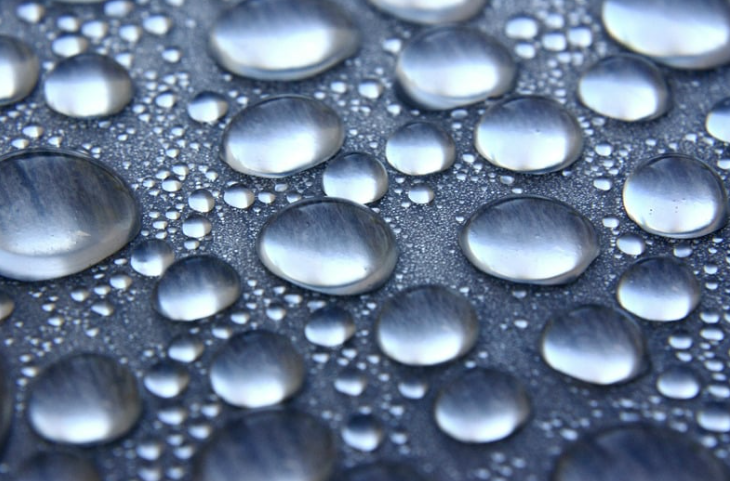
- Consequences: spherical droplets, meniscus formation, capillarity, soap bubbles, insects walking on water.
2) Definition & Units
Surface tension (also called surface force per unit length) is defined as
$$ T \equiv \frac{F}{L} $$
- SI unit: \( \mathrm{N\,m^{-1}} \)
- CGS unit: \( \mathrm{dyne\,cm^{-1}} \)
Surface energy: Work required to increase the surface area by unit amount. In SI, numerical value of surface energy per unit area equals \(T\) (J m\(^{-2}\) ↔ N m\(^{-1}\)).
3) Excess Pressure (Laplace law)
(a) Liquid drop (single interface)
For a spherical drop of radius \(r\):
$$ \Delta P = \frac{2T}{r} \quad \text{(inside higher than outside)} $$
(b) Soap bubble (two interfaces)
For a spherical bubble of radius \(r\):
$$ \Delta P = \frac{4T}{r} $$
These follow from mechanical equilibrium of a curved surface under tension.
4) Capillarity & Angle of Contact
Capillary rise/fall in a tube of radius \(r\):
$$ h = \frac{2T\cos\theta}{\rho g r} $$
- \(\theta\): angle of contact (acute for wetting liquids like water on glass → rise; obtuse for non-wetting like mercury on glass → fall).
- \(\rho\): density of liquid, \(g\): acceleration due to gravity.
Meniscus: Concave when adhesion \(>\) cohesion (\(\theta<90^\circ\)); convex when cohesion \(>\) adhesion (\(\theta>90^\circ\)).
5) Temperature & Impurities
- \(T\) decreases with temperature. Empirically: $$ T(T_{\text{abs}}) \approx T_0 \big(1 – k\,T_{\text{abs}}\big), \quad k>0. $$ \(T \to 0\) near the critical temperature.
- Surface-active agents (soaps/detergents) reduce \(T\) and enhance wetting/cleaning.
- Gas above liquid (air vs another immiscible liquid) also affects the measured \(T\).
6) Work & Energy at Surfaces
To create new area \( \Delta A \) at constant \(T\):
$$ W = T\,\Delta A, \qquad \text{so} \quad \frac{dW}{dA} = T. $$
Interpretation: \(T\) is the surface free energy per unit area (isothermal, reversible addition of area).
7) Typical Surface Tension Values (at ~20–25 °C)
| Liquid | Approx. \(T\) (N m\(^{-1}\)) | Remarks |
|---|---|---|
| Water | 0.072 | High; strong hydrogen bonding |
| Alcohol (ethanol) | ~0.022 | Lower than water |
| Glycerol | ~0.063 | Viscous, relatively high \(T\) |
| Mercury | ~0.485 | Very high; poor wetting on glass |
| Soap solution | ~0.025–0.040 | Reduced by surfactants |
Values are indicative for classroom use; exact values depend on temperature and purity.
8) Illustrative Examples
Ex. 1 — Excess pressure in soap bubble
For a bubble of radius \( r = 1.0\,\text{mm} \) with \( T = 0.030\,\mathrm{N\,m^{-1}} \):
$$ \Delta P = \frac{4T}{r} = \frac{4\times 0.030}{1.0\times 10^{-3}} = 120\,\text{Pa}. $$
Ex. 2 — Capillary rise of water
\( r = 0.50\,\text{mm},\; T = 0.072\,\mathrm{N\,m^{-1}},\; \rho = 1000\,\mathrm{kg\,m^{-3}},\; \theta \approx 0^\circ \):
$$ h = \frac{2T\cos\theta}{\rho g r} = \frac{2 \times 0.072 \times 1}{1000 \times 9.8 \times 0.5\times 10^{-3}} \approx 0.029\,\text{m} \;=\; 2.9\,\text{cm}. $$
9) Quick Checks
- State the SI unit of surface tension and surface energy per unit area.
Ans: Both numerically \( \mathrm{N\,m^{-1}} \) (and \( \mathrm{J\,m^{-2}} \) for surface energy).
- Why does mercury form a convex meniscus in glass?
Ans: Cohesion \( \gt \) adhesion ⇒ \( \theta > 90^\circ \).
- Show that \( h \propto \dfrac{1}{r} \) for a wetting liquid in a capillary.
Ans: From \( h=\dfrac{2T\cos\theta}{\rho g r} \) with \(T,\theta,\rho,g\) fixed.
10) Common Applications
- Cleaning action of soaps/detergents (reduced \(T\) improves wetting).
- Capillary action in plant xylem; wicks in lamps and pens.
- Drop formation, emulsions/foams stabilization with surfactants.
- Coating & printing processes (wetting, spread, leveling depend on \(T\) and \(\theta\)).
- \( T = \dfrac{F}{L} \)
- \( \Delta P_{\text{drop}} = \dfrac{2T}{r} \), \(\;\Delta P_{\text{bubble}} = \dfrac{4T}{r} \)
- \( h = \dfrac{2T\cos\theta}{\rho g r} \)
- \( W = T\,\Delta A \)
© SaitechAI — Prepared for Class 11 learners. You may print or save this page for study use.
Capillarity
Lecture Notes
Worksheet in Surface Tension, Surface Energy, Capillarity, contact angle, pressure inside the soap bubble.


