Posted on Leave a comment

Partial Fractions

Important Steps to Resolve Partial Fractions

  1. Ensure proper fraction:
    If degree(P) ≥ degree(Q), perform long division first.
  2. Factorize denominator completely.
  3. Assign constants (A, B, C, …) according to factor types.
  4. Multiply both sides by the denominator to eliminate fractions.
  5. Solve for constants by:
    • Substitution (plugging suitable x values), or
    • Comparing coefficients.
Partial Fractions – Lecture Notes | SaitechAI

Partial Fractions — Lecture Notes

SaitechAI Mathematics Lecture Series (Class 11–12, JEE/NEET Level)


1. Definition

A partial fraction expresses a rational function as a sum of simpler fractions. If \( \frac{P(x)}{Q(x)} \) is a rational function and \( \deg P(x) < \deg Q(x) \), it can be written as a sum of partial fractions.

2. Basic Rule

If \( \frac{P(x)}{Q(x)} \) is proper, its decomposition depends on the factors of \( Q(x) \):

  • Distinct Linear Factors: \( \frac{P(x)}{(x-a)(x-b)} = \frac{A}{x-a} + \frac{B}{x-b} \)
  • Repeated Linear Factors: \( \frac{P(x)}{(x-a)^2} = \frac{A}{x-a} + \frac{B}{(x-a)^2} \)
  • Irreducible Quadratic Factor: \( \frac{P(x)}{(x^2+bx+c)} = \frac{Ax + B}{x^2 + bx + c} \)

3. Steps to Resolve Partial Fractions

  1. Ensure the fraction is proper; if not, divide first.
  2. Factorize the denominator completely.
  3. Assign constants \(A, B, C, \dots\) based on factor types.
  4. Multiply by the denominator and remove fractions.
  5. Solve for constants by substitution or comparing coefficients.

4. Examples

Example 1:
\( \frac{3x – 5}{(x – 1)(x + 2)} = \frac{A}{x – 1} + \frac{B}{x + 2} \)
Multiply both sides by \( (x – 1)(x + 2) \): \( 3x – 5 = A(x + 2) + B(x – 1) \)
Let \( x = 1 \Rightarrow A = -\frac{2}{3} \); \( x = -2 \Rightarrow B = \frac{11}{3} \)
Final form: \( \frac{3x – 5}{(x – 1)(x + 2)} = \frac{-2/3}{x – 1} + \frac{11/3}{x + 2} \)

Example 2 (Repeated Factor):
\( \frac{2x + 3}{(x + 1)^2} = \frac{A}{x + 1} + \frac{B}{(x + 1)^2} \)
Multiply: \( 2x + 3 = A(x + 1) + B \)
Let \( x = -1 \Rightarrow B = 1 \); comparing coefficients → \( A = 2 \)
So, \( \frac{2x + 3}{(x + 1)^2} = \frac{2}{x + 1} + \frac{1}{(x + 1)^2} \)

Example 3 (Irreducible Quadratic):
\( \frac{2x^2 + 3x + 4}{(x + 1)(x^2 + 1)} = \frac{A}{x + 1} + \frac{Bx + C}{x^2 + 1} \)

5. Applications

  • Integration of rational functions
  • Laplace transforms
  • Electrical circuit analysis (RC, RL)
  • Control systems and differential equations

6. Common Mistakes

  • Not dividing when numerator degree ≥ denominator degree
  • Missing terms for repeated or quadratic factors
  • Incorrect coefficient comparison

7. Quick Practice Problems

  1. \( \frac{x + 2}{x^2 – 1} \)
  2. \( \frac{2x + 3}{(x – 1)^2} \)
  3. \( \frac{3x^2 + 5x + 2}{x(x + 1)(x + 2)} \)
  4. \( \frac{2x + 1}{x^2 + 4x + 5} \)

8. Integration via Partial Fractions

After decomposition, integrate each term separately:

\( \int \frac{A}{x – a} dx = A \ln|x – a| + C \)

\( \int \frac{Bx + C}{x^2 + px + q} dx = \text{Use substitution or arctan form} \)

© SaitechAI

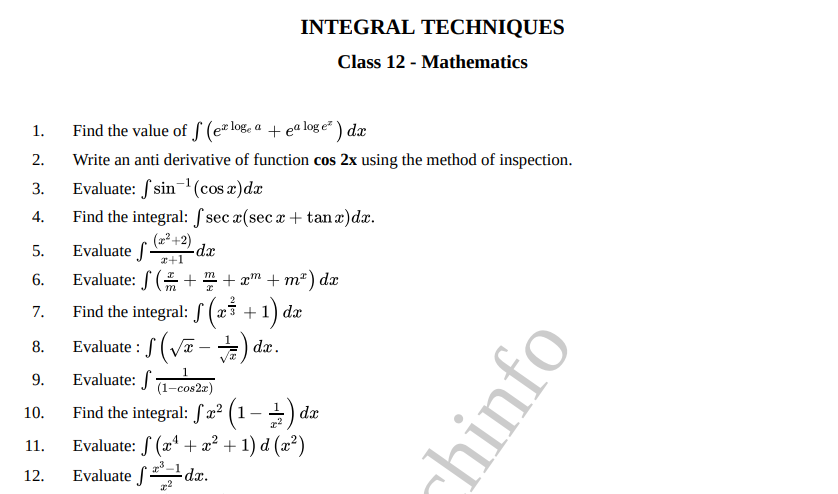
Worksheet – Set-1

Question
Question Image
SaitechAI

Problem 10 to 12

Posted on Leave a comment

Surface Tension

Video Lecture

Surface Tension

SaitechAI — Surface Tension (Class 11) Lecture Notes
SaitechAI

Surface Tension — Class 11 Lecture Notes

Physics (Properties of Fluids) · Rendered with MathJax

1) Concept & Molecular Picture

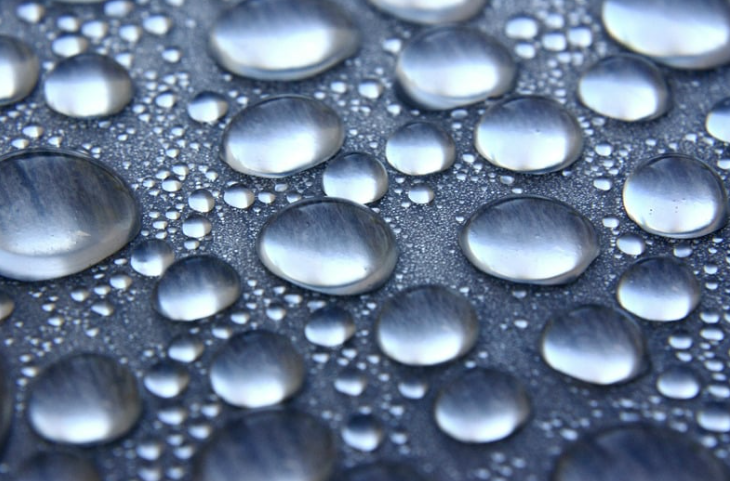
Idea: Molecules at the surface experience a net inward cohesive pull, making the surface behave like a stretched membrane.

  • Cohesion = attraction between molecules of the same liquid.
  • Adhesion = attraction between liquid and a different surface (e.g., glass).
  • Consequences: spherical droplets, meniscus formation, capillarity, soap bubbles, insects walking on water.

2) Definition & Units

Surface tension (also called surface force per unit length) is defined as

$$ T \equiv \frac{F}{L} $$

  • SI unit: \( \mathrm{N\,m^{-1}} \)
  • CGS unit: \( \mathrm{dyne\,cm^{-1}} \)

Surface energy: Work required to increase the surface area by unit amount. In SI, numerical value of surface energy per unit area equals \(T\) (J m\(^{-2}\) ↔ N m\(^{-1}\)).

3) Excess Pressure (Laplace law)

(a) Liquid drop (single interface)

For a spherical drop of radius \(r\):

$$ \Delta P = \frac{2T}{r} \quad \text{(inside higher than outside)} $$

(b) Soap bubble (two interfaces)

For a spherical bubble of radius \(r\):

$$ \Delta P = \frac{4T}{r} $$

These follow from mechanical equilibrium of a curved surface under tension.

4) Capillarity & Angle of Contact

Capillary rise/fall in a tube of radius \(r\):

$$ h = \frac{2T\cos\theta}{\rho g r} $$

  • \(\theta\): angle of contact (acute for wetting liquids like water on glass → rise; obtuse for non-wetting like mercury on glass → fall).
  • \(\rho\): density of liquid, \(g\): acceleration due to gravity.

Meniscus: Concave when adhesion \(>\) cohesion (\(\theta<90^\circ\)); convex when cohesion \(>\) adhesion (\(\theta>90^\circ\)).

5) Temperature & Impurities

  • \(T\) decreases with temperature. Empirically: $$ T(T_{\text{abs}}) \approx T_0 \big(1 – k\,T_{\text{abs}}\big), \quad k>0. $$ \(T \to 0\) near the critical temperature.
  • Surface-active agents (soaps/detergents) reduce \(T\) and enhance wetting/cleaning.
  • Gas above liquid (air vs another immiscible liquid) also affects the measured \(T\).

6) Work & Energy at Surfaces

To create new area \( \Delta A \) at constant \(T\):

$$ W = T\,\Delta A, \qquad \text{so} \quad \frac{dW}{dA} = T. $$

Interpretation: \(T\) is the surface free energy per unit area (isothermal, reversible addition of area).

7) Typical Surface Tension Values (at ~20–25 °C)

LiquidApprox. \(T\) (N m\(^{-1}\))Remarks
Water0.072High; strong hydrogen bonding
Alcohol (ethanol)~0.022Lower than water
Glycerol~0.063Viscous, relatively high \(T\)
Mercury~0.485Very high; poor wetting on glass
Soap solution~0.025–0.040Reduced by surfactants

Values are indicative for classroom use; exact values depend on temperature and purity.

8) Illustrative Examples

Ex. 1 — Excess pressure in soap bubble

For a bubble of radius \( r = 1.0\,\text{mm} \) with \( T = 0.030\,\mathrm{N\,m^{-1}} \):

$$ \Delta P = \frac{4T}{r} = \frac{4\times 0.030}{1.0\times 10^{-3}} = 120\,\text{Pa}. $$

Ex. 2 — Capillary rise of water

\( r = 0.50\,\text{mm},\; T = 0.072\,\mathrm{N\,m^{-1}},\; \rho = 1000\,\mathrm{kg\,m^{-3}},\; \theta \approx 0^\circ \):

$$ h = \frac{2T\cos\theta}{\rho g r} = \frac{2 \times 0.072 \times 1}{1000 \times 9.8 \times 0.5\times 10^{-3}} \approx 0.029\,\text{m} \;=\; 2.9\,\text{cm}. $$

9) Quick Checks

  1. State the SI unit of surface tension and surface energy per unit area.
    Ans: Both numerically \( \mathrm{N\,m^{-1}} \) (and \( \mathrm{J\,m^{-2}} \) for surface energy).
  2. Why does mercury form a convex meniscus in glass?
    Ans: Cohesion \( \gt \) adhesion ⇒ \( \theta > 90^\circ \).
  3. Show that \( h \propto \dfrac{1}{r} \) for a wetting liquid in a capillary.
    Ans: From \( h=\dfrac{2T\cos\theta}{\rho g r} \) with \(T,\theta,\rho,g\) fixed.

10) Common Applications

  • Cleaning action of soaps/detergents (reduced \(T\) improves wetting).
  • Capillary action in plant xylem; wicks in lamps and pens.
  • Drop formation, emulsions/foams stabilization with surfactants.
  • Coating & printing processes (wetting, spread, leveling depend on \(T\) and \(\theta\)).
Formula Sheet (at a glance)
  • \( T = \dfrac{F}{L} \)
  • \( \Delta P_{\text{drop}} = \dfrac{2T}{r} \), \(\;\Delta P_{\text{bubble}} = \dfrac{4T}{r} \)
  • \( h = \dfrac{2T\cos\theta}{\rho g r} \)
  • \( W = T\,\Delta A \)

© SaitechAI — Prepared for Class 11 learners. You may print or save this page for study use.

Capillarity

Lecture Notes

Worksheet in Surface Tension, Surface Energy, Capillarity, contact angle, pressure inside the soap bubble.

Worksheet set-2

Worksheet set-3

Question
Question Image Question Image
SaitechAI

Doubt Clinic Worksheets

Question Number 6 in worksheet set-2

Posted on Leave a comment

Dynamic Modern Periodic Table

Modern Periodic Table — Lecture Notes (Class 11, SaitechAI Edition)


1. Historical Development

  • Dobereiner’s Triads (1829): Elements were grouped in triads with similar properties. The atomic mass of the middle element was approximately the mean of the other two.
    Example: Li (7), Na (23), K (39).
  • Newlands’ Law of Octaves (1865): Every eighth element showed similar properties when arranged by increasing atomic mass.
  • Mendeleev’s Periodic Law (1869): The properties of elements are periodic functions of their atomic masses.
    Limitations: Position of isotopes, anomalous pairs (Co–Ni, Te–I).
  • Modern Periodic Law (Moseley, 1913): “The physical and chemical properties of elements are periodic functions of their atomic numbers.”

2. Structure of the Modern Periodic Table

  • Basis: Atomic number (Z)
  • Total elements: 118 (known till 2025)
  • Periods: 7 horizontal rows (number of energy shells)
  • Groups: 18 vertical columns (number of valence electrons)
  • Block classification:
    • s-block: Groups 1 & 2
    • p-block: Groups 13–18
    • d-block: Transition elements (Groups 3–12)
    • f-block: Inner transition elements (Lanthanides & Actinides)

3. Features of Periods and Groups

FeaturePeriodsGroups
Number718
RepresentsPrincipal quantum number (n)Valence shell configuration
Example2nd period → Li to NeGroup 17 → Halogens (F, Cl, Br, I, At)

4. Important Trends in the Periodic Table

(a) Atomic Radius

  • ↓ Group → increases (new shells added)
  • → Period → decreases (nuclear charge ↑)

(b) Ionization Enthalpy (IE)

  • ↓ Group → decreases (outer electrons farther)
  • → Period → increases (nuclear charge ↑)

(c) Electron Gain Enthalpy (EGE)

  • → Period → generally becomes more negative
  • ↓ Group → becomes less negative
  • Exception: Noble gases have positive EGE.

(d) Electronegativity

  • → Period → increases
  • ↓ Group → decreases
  • Pauling scale: F = 4.0 (highest)

(e) Metallic and Nonmetallic Character

  • Metallic character ↓ across a period, ↑ down a group.
  • Nonmetallic character shows reverse trend.

(f) Valency

  • Depends on group number:
    • Group 1 → valency 1
    • Group 14 → valency 4
    • Group 17 → valency 1
    • Group 18 → valency 0

5. Anomalies and Exceptions

  • Diagonal relationship: Li–Mg, Be–Al (similar properties)
  • d-Block contraction: due to poor shielding of d-electrons.
  • Lanthanide contraction: causes Zr–Hf similarity.

6. Applications

  • Predicting properties of elements.
  • Classifying unknown elements.
  • Understanding chemical reactivity.
  • Basis for electronic configuration and chemical bonding.

7. Modern Periodic Table Snapshot

BlockRangeExample ElementsCharacteristic
s-block1–2Na, MgHighly reactive metals
p-block13–18B, C, N, O, FIncludes nonmetals, metalloids
d-block3–12Fe, Cu, ZnTransition metals
f-blockLanthanoids, ActinoidsCe, UInner transition metals

8. Mathematical Expression

where ( Z ) = atomic number, ( p ) = number of protons, ( n ) = neutrons.

9. Quick Revision Points

  • Elements arranged by atomic number.
  • Periodicity due to repetition of similar electronic configuration.
  • Noble gases show complete outer shells → inert nature.
  • Across a period: metallic → nonmetallic transition.
  • Down a group: atomic size ↑, ionization energy ↓.

SaitechAI • Dynamic Modern Periodic Table (Crosshair + Auto Details)
SaitechAI
Dynamic Periodic Table • Draggable Crosshair
Posted on Leave a comment

Lewis Structure

Study Notes

1. Introduction to Lewis Structures

  • Developed by Gilbert N. Lewis (1916) to represent covalent bonding.
  • Also called electron dot structures.
  • Show valence electrons as dots and bond pairs as lines.
  • Help predict molecular shape, polarity, and reactivity.

2. Basic Rules

Check formal charge to find the most stable structure.

Count valence electrons of all atoms.

Arrange atoms: the least electronegative atom is usually central (except H).

Form bonds by pairing electrons between atoms.

Complete octets of outer atoms first, then central atom.

Use multiple bonds (double/triple) if needed to satisfy octet.

Video Lecture – Playlist


3. Formal Charge Formula

  • Lower formal charges = more stable.
  • Negative charge should reside on more electronegative atoms.

4. Examples

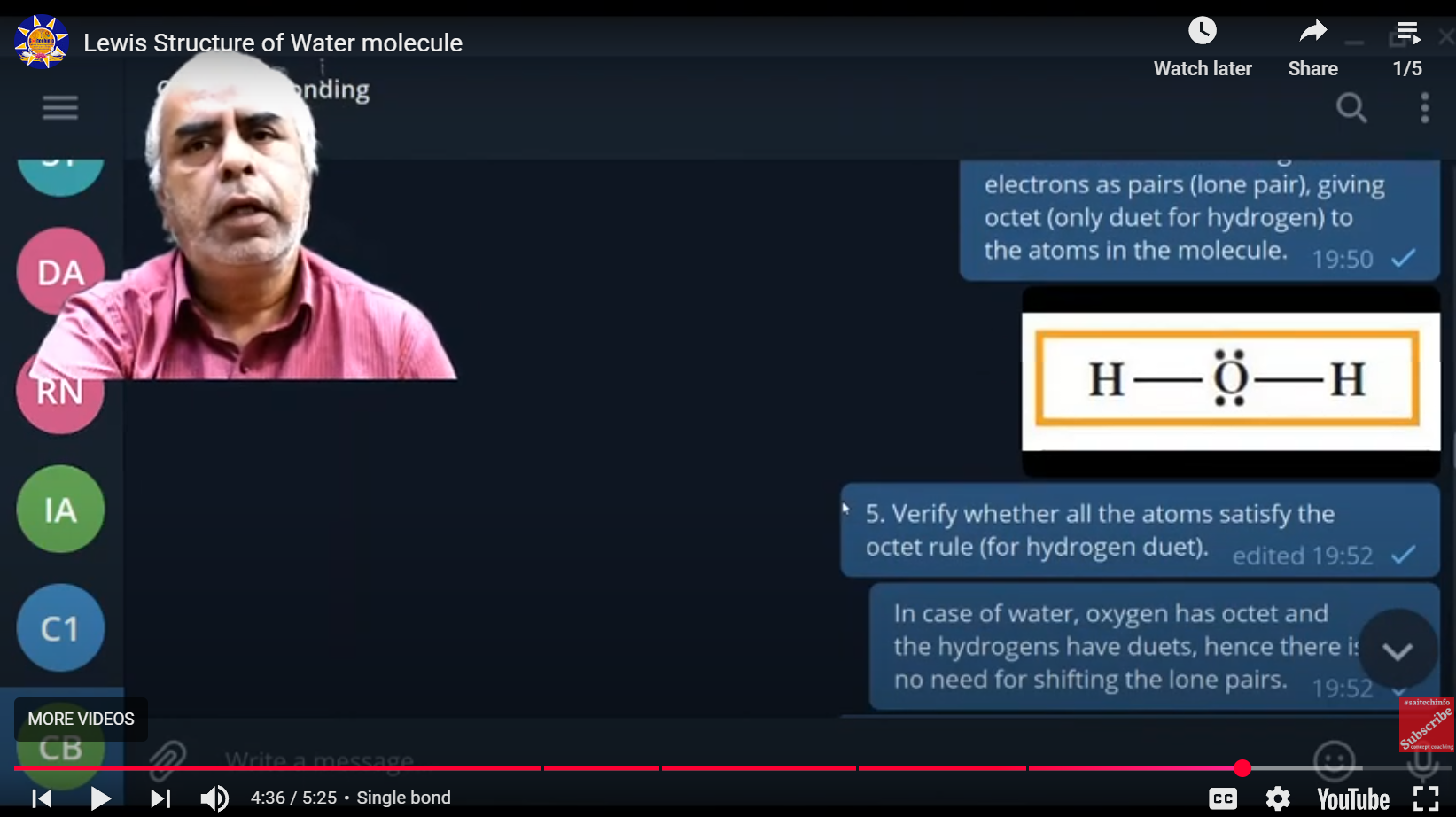
  • Water (H₂O): O is central, 2 lone pairs, 2 bonds with H.
  • CO₂: C in center, 2 double bonds with O, no lone pairs on C.
  • Ozone (O₃): Resonance structure with one double and one single bond, formal charges adjusted.
  • Ammonium ion (NH₄⁺): 4 bonds around N, no lone pair, positive charge.

5. Resonance

  • Occurs when more than one valid structure exists.
  • Real structure = hybrid of resonance forms.
  • Example: Benzene (C₆H₆), O₃.

6. Limitations

  • Does not show 3D geometry (use VSEPR theory).
  • Cannot explain delocalization completely (needs MO theory).
  • Fails for some transition metal complexes.

7. Importance

  • Foundation for VSEPR theory (shapes).
  • Useful in predicting reactivity sites in organic chemistry.
  • Basis for acid-base theories (Lewis acids/bases).

Key Terms in Lewis Structure

  1. Valence-Electrons – Electrons in the outermost shell that participate in bonding.
  2. Electron-Dot-Structure – Representation of atoms showing valence electrons as dots.
  3. Bonding-Pair – A pair of electrons shared between two atoms forming a covalent bond.
  4. Lone-Pair – A pair of valence electrons not involved in bonding.
  5. Central-Atom – The least electronegative atom (except hydrogen) placed at the center of a Lewis structure.
  6. Octet-Rule – Atoms tend to achieve eight electrons in their valence shell for stability.
  7. Duet-Rule – Hydrogen attains stability with only two valence electrons.
  8. Double-Bond – Two shared pairs of electrons between the same two atoms.
  9. Triple-Bond – Three shared pairs of electrons between the same two atoms.
  10. Formal-Charge – Hypothetical charge calculated by assuming equal sharing of bonding electrons.
  11. Resonance-Structure – Different valid electron arrangements for the same molecule.
  12. Charge-Delocalization – Distribution of electron density across multiple atoms due to resonance.
  13. Expanded-Octet – Central atom holding more than eight electrons, possible in period 3 and beyond.
  14. Incomplete-Octet – Central atom with fewer than eight electrons, common in Be and B compounds.
  15. Lewis-Acid – Species that accepts an electron pair to form a bond.

Activities

Online MCQ Test

Posted on Leave a comment

Integrals

Level STD 12 CBSE | Maths

Topic Tree

I. Indefinite Integrals

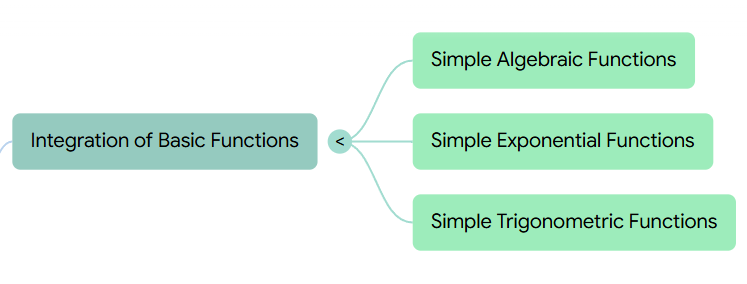
  1. Integration of Simple Algebraic Functions and Simple Exponential Functions
  2. Integration of Simple Trigonometric Functions
  3. Integration by Substitution
  4. Integration of Odd & Even Powers of sin xcos x and tan x
  5. Integration Using Standard Formulae
  6. Directly using Formulae & Special Types of Integrals
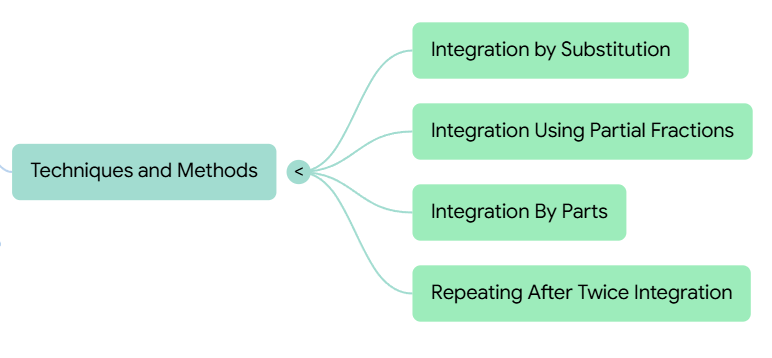
  1. Integration Using Partial Fractions
  2. Integration By Parts
  3. Repeating After Twice Integration
  4. Integrals of Exponential Forms
  5. Three More Formulae for Integration
  6. Integration of Special functions

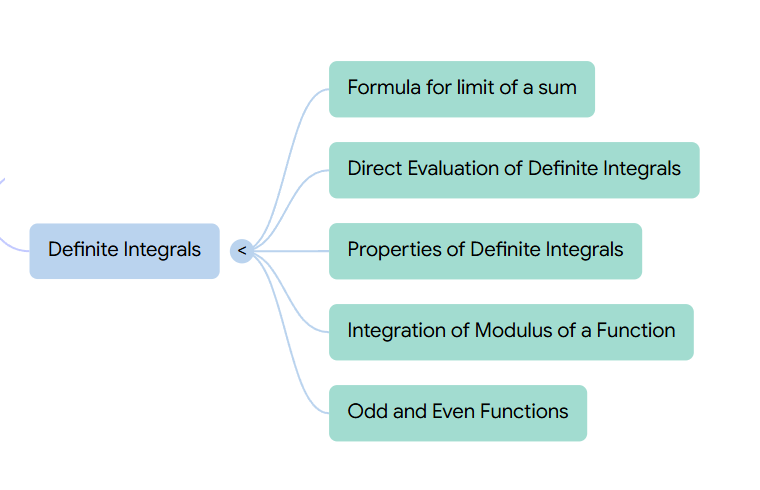
II. Definite Integrals

  1. Formula for limit of a sum
  2. Direct Evaluation of Definite Integrals
  3. Properties of Definite Integrals
  4. Integration of Modulus of a Function
  5. Odd and Even Functions

Introduction

Concept maps and flashcards

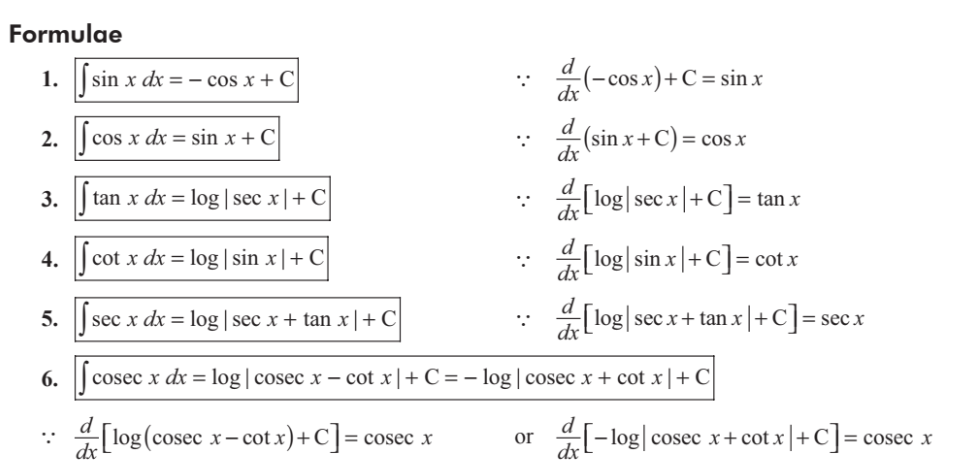
  1. Partial fraction techniques in integrals
  2. Integrals flash cards
  3. Integrals Formulae

NOTES

Integrals – an introduction

Antiderivative by method of inspection

Quiz in Antiderivatives – Activity

Antiderivatives – worksheet-1 | worksheet-2

Basic formula of Integrals

Substitution MethodsWorksheet-1 | Worksheet-2 | Worksheet-3

Integral by parts

Partial Fractions Decomposition

Unit Test-1

Sketch note summary and Mnemonics

Question Bank

  1. Integrals one mark questions | Key
  2. Integrals by substitution questions | Key
  3. Unit test | Set-1 | Key-1 | Set-2 | Key-2 | Set-3 | Key-3 | Set-4 | Key-4 | Set-5 | Key-5

Video

  1. Integrals part 1
  2. Integrals part 2
  3. Integral of sin x . sin(cos x)dx solved by Gokul
  4. Doubt clinic session on integrals
  5. Definite integral part 1
  6. Integral by parts by Bernoullis formula demonstrated by Pavani, Hari and Dhanusri
  7. Integral problem using partial fraction
  8. Integral problem with trigonometry formula and substitution method a tutorial session with shreya
  9. Definite integral as limit of sum example problem 2
  10. Definite integral as limit of sum theory part 1
  11. Definite integral as a limit of sum
  12. Definite integral as limit of sum theory part 2
  13. Definite integral as limit of sum theory part 3
  14. Definite integral as limit of sum theory part 4
  15. Integral between the limits 0 and pi of x . (sin^2(sin x) + cos^2(cos x) dx presented by Shravanth
  16. Recitation of some trigonometric formulae used in integrals
  17. Integration demo

PPT Notes

  1. Integrals of trigonometric functions

Additional Notes

  1. Integral doubt question 1
  2. Integral doubt question 2
  3. Integral doubt question 3