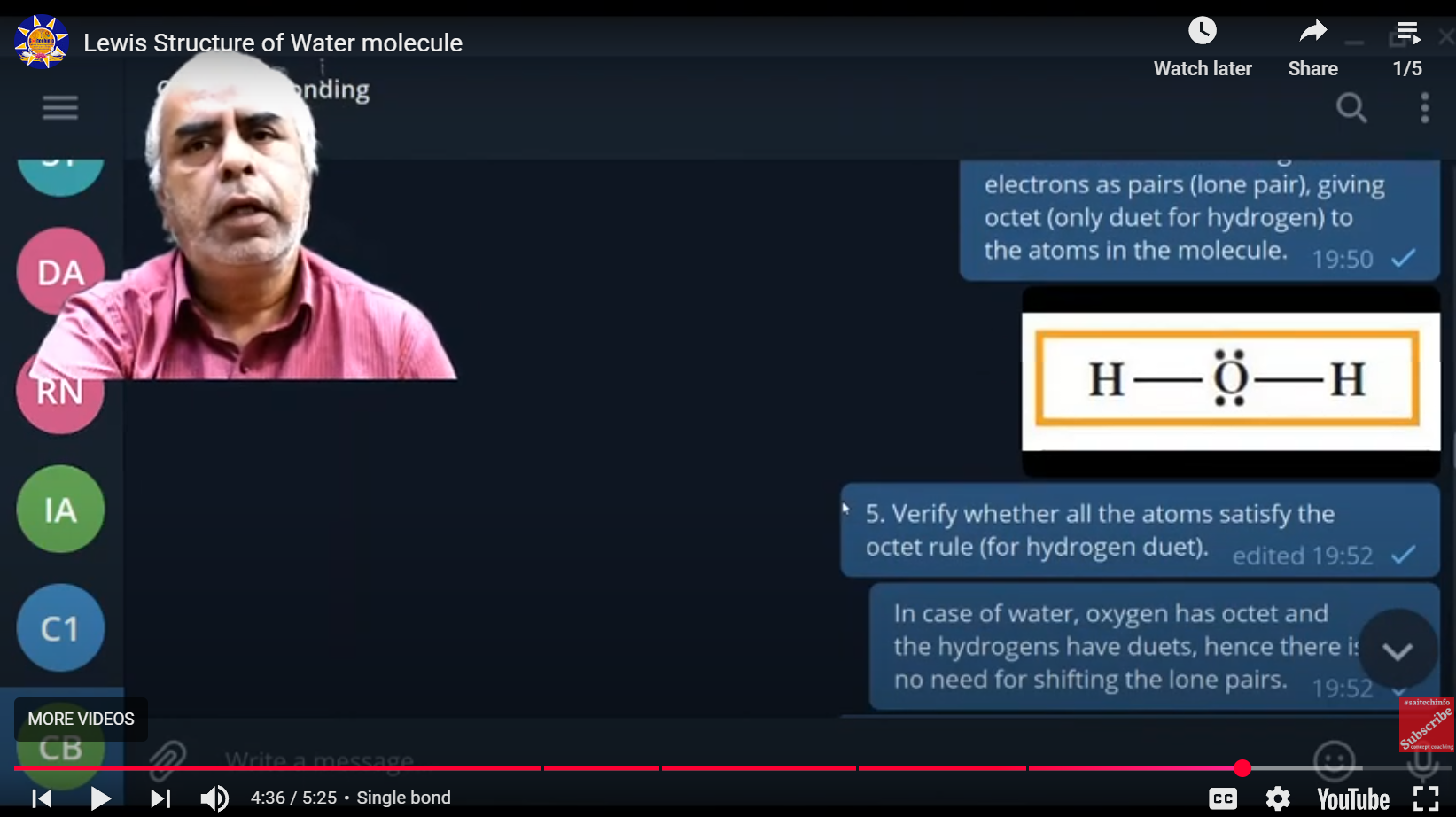
Study Notes
1. Introduction to Lewis Structures
- Developed by Gilbert N. Lewis (1916) to represent covalent bonding.
- Also called electron dot structures.
- Show valence electrons as dots and bond pairs as lines.
- Help predict molecular shape, polarity, and reactivity.
2. Basic Rules
Check formal charge to find the most stable structure.
Count valence electrons of all atoms.
Arrange atoms: the least electronegative atom is usually central (except H).
Form bonds by pairing electrons between atoms.
Complete octets of outer atoms first, then central atom.
Use multiple bonds (double/triple) if needed to satisfy octet.
Video Lecture – Playlist
3. Formal Charge Formula

- Lower formal charges = more stable.
- Negative charge should reside on more electronegative atoms.
4. Examples
- Water (H₂O): O is central, 2 lone pairs, 2 bonds with H.
- CO₂: C in center, 2 double bonds with O, no lone pairs on C.
- Ozone (O₃): Resonance structure with one double and one single bond, formal charges adjusted.
- Ammonium ion (NH₄⁺): 4 bonds around N, no lone pair, positive charge.
5. Resonance
- Occurs when more than one valid structure exists.
- Real structure = hybrid of resonance forms.
- Example: Benzene (C₆H₆), O₃.
6. Limitations
- Does not show 3D geometry (use VSEPR theory).
- Cannot explain delocalization completely (needs MO theory).
- Fails for some transition metal complexes.
7. Importance
- Foundation for VSEPR theory (shapes).
- Useful in predicting reactivity sites in organic chemistry.
- Basis for acid-base theories (Lewis acids/bases).
Key Terms in Lewis Structure
- Valence-Electrons – Electrons in the outermost shell that participate in bonding.
- Electron-Dot-Structure – Representation of atoms showing valence electrons as dots.
- Bonding-Pair – A pair of electrons shared between two atoms forming a covalent bond.
- Lone-Pair – A pair of valence electrons not involved in bonding.
- Central-Atom – The least electronegative atom (except hydrogen) placed at the center of a Lewis structure.
- Octet-Rule – Atoms tend to achieve eight electrons in their valence shell for stability.
- Duet-Rule – Hydrogen attains stability with only two valence electrons.
- Double-Bond – Two shared pairs of electrons between the same two atoms.
- Triple-Bond – Three shared pairs of electrons between the same two atoms.
- Formal-Charge – Hypothetical charge calculated by assuming equal sharing of bonding electrons.
- Resonance-Structure – Different valid electron arrangements for the same molecule.
- Charge-Delocalization – Distribution of electron density across multiple atoms due to resonance.
- Expanded-Octet – Central atom holding more than eight electrons, possible in period 3 and beyond.
- Incomplete-Octet – Central atom with fewer than eight electrons, common in Be and B compounds.
- Lewis-Acid – Species that accepts an electron pair to form a bond.
Activities
