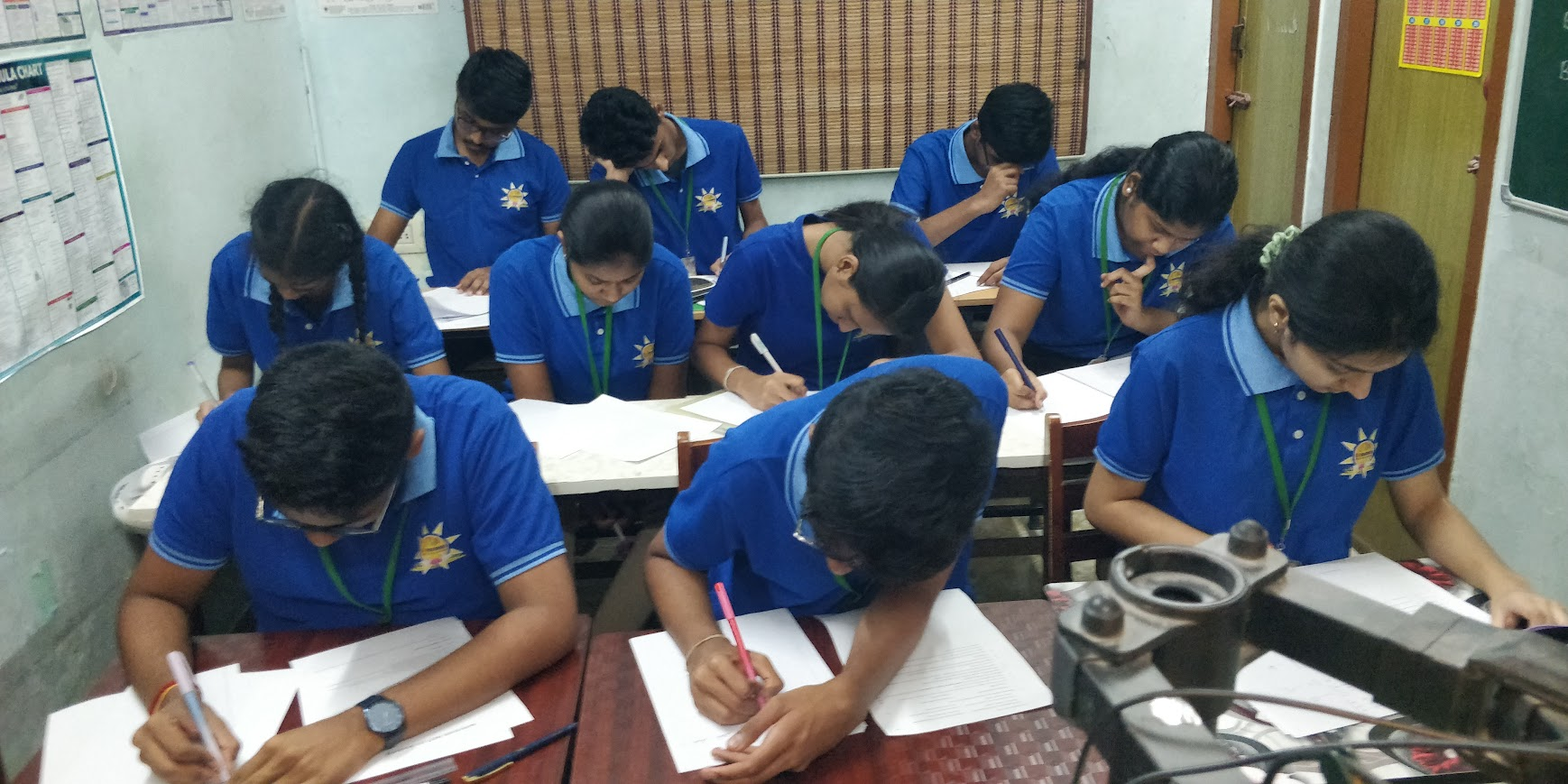
Daily recall (FC/QB/GP) strengthens memory traces; timed TP develops exam composure; UTs provide objective feedback to re-route the next cycle. Small wins, every day.
Dr E. Ramanathan PhD | Class 11 Physics | Surface Tension
This problem is based on coalescience of liquid drops in the Surface Tension topic of Class 11 Physics.
Concept Explanation — Energy Released on Coalescence of Liquid Drops
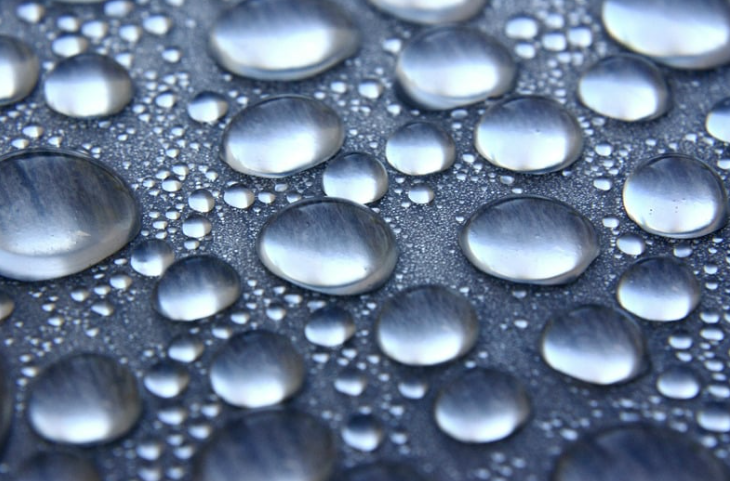
When two small liquid drops merge (coalesce) to form a single larger drop, the total surface area decreases because the surface-to-volume ratio reduces. Since surface energy is directly proportional to surface area, this reduction leads to a release of surface energy in the form of heat or kinetic energy.
4. Interpretation
The merged drop has less total surface area.
The difference in surface energy (due to reduced surface area) appears as released energy.
Hence, energy released = decrease in surface area × surface tension.
Key Insight
Smaller drops have higher surface area per unit volume, meaning higher surface energy. When they combine into a larger drop, the surface area reduces → surface energy decreases → energy is released.
Targeted help removes bottlenecks quickly, keeps momentum with school work, and builds confidence by converting every doubt into a solved example or mastered concept.
Ideal during homework rush, pre-unit tests, and revision weeks.
Perfect for bridging gaps after a difficult school test.
Scales from a single doubt to a full topic sprint before exams.
Cost-effective Doubt Clarification for Class 9–12, NEET & JEE
Selective coaching that fits your schedule and budget — focused clarifications, topic-level tuitions, smart time management, and stress-balanced preparation aligned with school demands.
🎯
Selective Coaching
Pay only for what you need — a single question, a tricky concept, or one full topic.
🧠
Concept Clarity
Micro-lessons (ConceptDrone) to resolve root confusions and build durable understanding.
📘
Topic-Level Tuitions
Compact topic sprints with examples, practice, and quick assessments.
⏱️
Time Management
Short sessions fit around school, saving commute time and preventing burnout.
📚
School-Aligned Support
Balanced with homework, daily tests, revisions, and unit schedules.
🧾
Question-Paper Help
Doubt clarification directly on school test question papers with stepwise solutions.
✅
Recover after low scores — rapid remediation plan and re-attempt strategies.
Targeted help removes bottlenecks quickly, keeps momentum with school work, and builds confidence by converting every doubt into a solved example or mastered concept.
Ideal during homework rush, pre-unit tests, and revision weeks.
Perfect for bridging gaps after a difficult school test.
Scales from a single doubt to a full topic sprint before exams.
Surface tension (also called surface force per unit length) is defined as
$$ T \equiv \frac{F}{L} $$
SI unit: \( \mathrm{N\,m^{-1}} \)
CGS unit: \( \mathrm{dyne\,cm^{-1}} \)
Surface energy: Work required to increase the surface area by unit amount. In SI, numerical value of surface energy per unit area equals \(T\) (J m\(^{-2}\) ↔ N m\(^{-1}\)).
3) Excess Pressure (Laplace law)
(a) Liquid drop (single interface)
For a spherical drop of radius \(r\):
$$ \Delta P = \frac{2T}{r} \quad \text{(inside higher than outside)} $$
(b) Soap bubble (two interfaces)
For a spherical bubble of radius \(r\):
$$ \Delta P = \frac{4T}{r} $$
These follow from mechanical equilibrium of a curved surface under tension.
4) Capillarity & Angle of Contact
Capillary rise/fall in a tube of radius \(r\):
$$ h = \frac{2T\cos\theta}{\rho g r} $$
\(\theta\): angle of contact (acute for wetting liquids like water on glass → rise; obtuse for non-wetting like mercury on glass → fall).
\(\rho\): density of liquid, \(g\): acceleration due to gravity.
Meniscus: Concave when adhesion \(>\) cohesion (\(\theta<90^\circ\)); convex when cohesion \(>\) adhesion (\(\theta>90^\circ\)).
5) Temperature & Impurities
\(T\) decreases with temperature. Empirically:
$$ T(T_{\text{abs}}) \approx T_0 \big(1 – k\,T_{\text{abs}}\big), \quad k>0. $$
\(T \to 0\) near the critical temperature.
Surface-active agents (soaps/detergents) reduce \(T\) and enhance wetting/cleaning.
Gas above liquid (air vs another immiscible liquid) also affects the measured \(T\).
6) Work & Energy at Surfaces
To create new area \( \Delta A \) at constant \(T\):
$$ W = T\,\Delta A, \qquad \text{so} \quad \frac{dW}{dA} = T. $$
Interpretation: \(T\) is the surface free energy per unit area (isothermal, reversible addition of area).
7) Typical Surface Tension Values (at ~20–25 °C)
Liquid
Approx. \(T\) (N m\(^{-1}\))
Remarks
Water
0.072
High; strong hydrogen bonding
Alcohol (ethanol)
~0.022
Lower than water
Glycerol
~0.063
Viscous, relatively high \(T\)
Mercury
~0.485
Very high; poor wetting on glass
Soap solution
~0.025–0.040
Reduced by surfactants
Values are indicative for classroom use; exact values depend on temperature and purity.
8) Illustrative Examples
Ex. 1 — Excess pressure in soap bubble
For a bubble of radius \( r = 1.0\,\text{mm} \) with \( T = 0.030\,\mathrm{N\,m^{-1}} \):
என்ற லிங்கிற்கு அனுப்பவும் . அதற்கான பாஸ் கோடு உங்கள் ஆசிரியரிடம் உள்ளது .
Live Session
சுருக்கம் .
தமிழக வரலாற்றில் வேதியியல்
1. முன்னுரை
தமிழக வரலாற்று பண்பாட்டில் வேதியியல் முக்கிய பங்கு வகித்துள்ளது. சங்க காலத்திலிருந்தே உலோகவியல், வண்ணப்பூச்சு, மருத்துவம், சுரங்கவியல் ஆகிய துறைகளில் வேதியியல் அறிவு நடைமுறையில் இருந்தது.
2. உலோகவியல் (Metallurgy)
சங்க காலம்: பாண்டியர், சோழர், சேரர் இராச்சியங்களில் இரும்பு உருக்கல் தொழில் முன்னேற்றம் பெற்றது.
வெள்ளி, தங்கம், பித்தளை: கோவில் உபகரணங்கள், நாணயங்கள் தயாரிப்பில் பயன்படுத்தப்பட்டது.
வாள்கள், ஆயுதங்கள்: வூட்சு ஸ்டீல் (Wootz steel) தமிழ்நாட்டின் பெருமை; உலகப் புகழ்பெற்ற டமாஸ்கஸ் வாள்கள் இதிலிருந்து வந்தன.
3. சாயங்கள் மற்றும் நிறப்பூச்சுகள்
ஆடைத் தொழில்: காஞ்சிபுரம் பட்டு, மதுரை சால்வை முதலியவை இயற்கைச் சாயங்களால் நிறமூட்டப்பட்டது.
இயற்கை வண்ணக் கரைகள்:
மஞ்சள் – மஞ்சள் தூள் (Curcumin).
சிவப்பு – மஞ்சிஸ்தா (Rubia cordifolia), செம்மரம்.
நீலம் – காட்டு நீலவாழை (Indigofera tinctoria).
இவை அனைத்தும் கரிம வேதியியல் அடிப்படையில் நிறக்கூறுகளை வழங்கின.
உலோகம் அடிப்படையிலான மருந்துகள்: பித்தளை, வெள்ளி, தங்க பசைகள் (Bhasma).
ஆரோக்கியக் குணங்கள்: சாம்பிராணி, கற்பூரம், சுண்ணாம்பு போன்றவை கிருமி நாசினி.
பெருங்காயம், சீரகம், இஞ்சி போன்றவை இயற்கை கரிமக் கூட்டுப் பொருட்கள்.
5. கோவில்கள் மற்றும் கட்டடக் கலையில் வேதியியல்
சுண்ணாம்பு + முட்டை வெள்ளை + பனைசாறு கலவை – பழமையான சிமெண்டு (lime mortar).
கல் சிலைகள்: கிரானைட், சுண்ணாம்பு கற்கள் வெட்டும் தொழில்நுட்பம்.
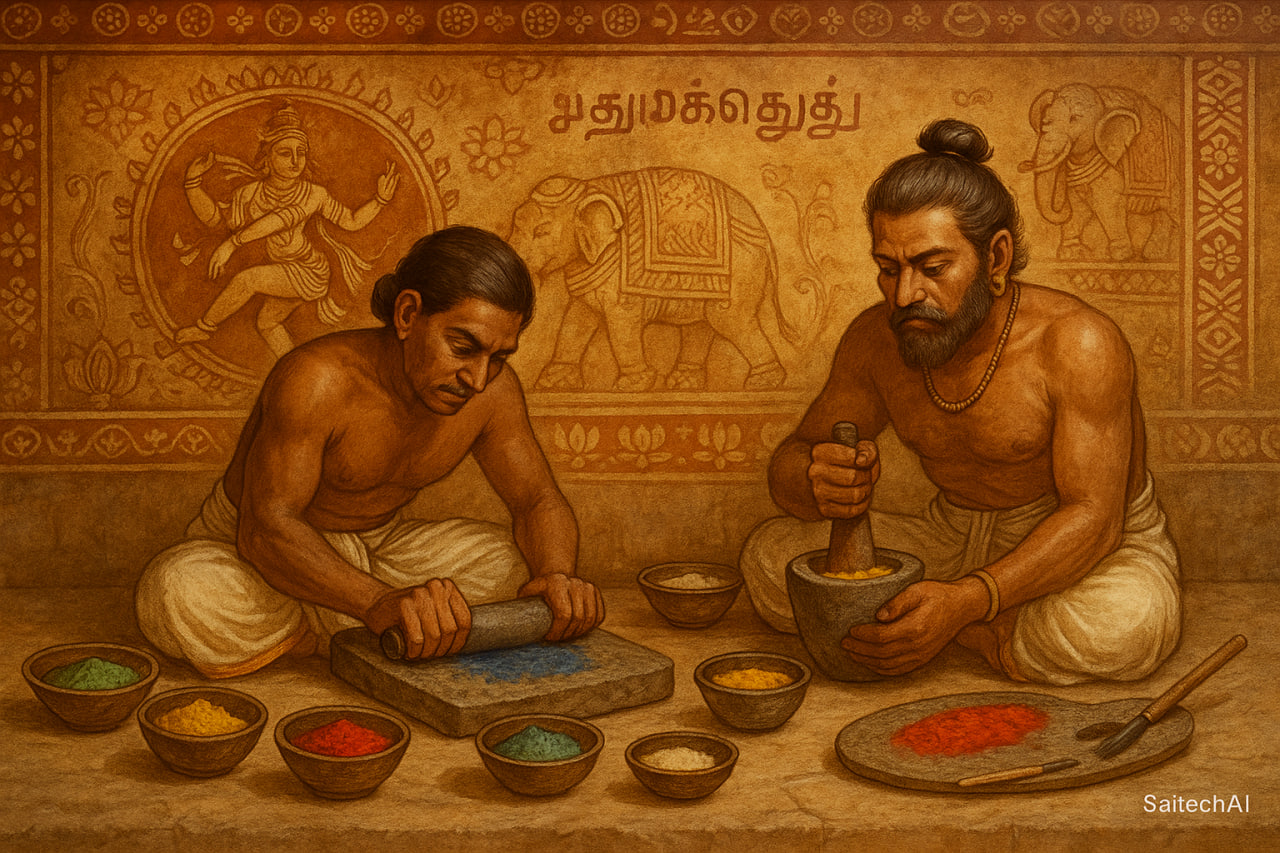
சாயக்கூட்டுகள்: கோவில் ஓவியங்களில் இயற்கை கனிமச் சாயங்கள்.
சிவப்பு – குருதி மணல் (Red ochre, Fe₂O₃).
மஞ்சள் – மஞ்சள் மணல் (Yellow ochre, hydrated Fe₂O₃).
கருப்பு – கரிச்சாணம், கரியமான் கரி (Carbon black).
6. விவசாயம் மற்றும் வேதியியல்
சங்க இலக்கியம்: நிலம், நீர், உழவு பற்றிய குறிப்புகள்.
உயிர்வளம் அதிகரிப்பு: மாட்டுச் சாணம், பசுநீர் (urine) – இயற்கை நைட்ரஜன் மூலப்பொருள்.
பாசனக் கட்டமைப்பு: சோழர் காலக் கால்வாய்கள். நீரின் வேதியியல் சுத்திகரிப்பு நடைமுறைகள்.
7. கடல்சார் வர்த்தகம் மற்றும் வேதியியல்
சோழர் காலத்தில் அரோமாட்டிக் பொருட்கள் (சாம்பிராணி, அகர்பத்தி, கற்பூரம்) தென்கிழக்கு ஆசியாவிற்குக் கொண்டு செல்லப்பட்டது.
உப்புத்தொழில்: கடல் நீர் ஆவியாக்கம் மூலம் NaCl எடுப்பு.
சுண்ணாம்பு எரிப்பு: CaCO₃ → CaO + CO₂.
8. தமிழ்ப் பண்டிதர்கள் மற்றும் வேதியியல் சிந்தனைகள்
அகத்தியர்: வேதியியல் அடிப்படையிலான சித்த மருத்துவக் குறிப்புகள்.
போகர்: நவபாசாணம் (nine-poison stone) – ஆலயம் மண்டபத்தில் விஞ்ஞான அடிப்படையில் கலவை.
தேரையர்: மருத்துவ வேதியியல் நூல்கள்.
9. முடிவு
தமிழக வரலாற்றில் வேதியியல்:
ஆயுதங்களில் – வூட்சு ஸ்டீல்.
ஆடைகளில் – இயற்கைச் சாயங்கள்.
மருத்துவத்தில் – சித்த வேதியியல்.
கட்டிடங்களில் – சுண்ணாம்பு மற்றும் கனிமங்கள்.
வர்த்தகத்தில் – உப்பு, சாம்பிராணி, கற்பூரம்.
இவை அனைத்தும் தமிழர் வாழ்வியலோடு கலந்து, உலகளவில் அறிவியல் முன்னேற்றத்தில் பங்களித்துள்ளன.
Article
The Evolution of Chemistry in Tamil Nadu History: A Legacy of Technology, Medicine, and Art
Dr. E. Ramanathan, PhD (Chemistry)
Abstract
This paper explores the evolution of chemistry in Tamil Nadu through multiple historical lenses—technology, medicine, art, and trade. Drawing evidence from Sangam literature, archaeological studies, metallurgical analyses of Wootz steel, ethnographic accounts of Siddha medicine, and art-history surveys of temple murals, it argues that Tamil civilization displayed a highly integrative application of chemical knowledge. A comparative perspective demonstrates both continuity with global practices (e.g., metallurgy in China, Islamic alchemy, Greco-Roman dyes) and Tamil Nadu’s unique contributions (e.g., Wootz steel, Navapasanam, organic dye technology).
1. Introduction: Chemistry Interwoven with Tamil Culture
In Tamil Nadu, chemistry (வேதியியல்) was not an abstract discipline but deeply embedded in everyday life, spanning agriculture, trade, weaponry, religious practice, and medicine. The Sangam corpus (300 BCE–300 CE) provides early poetic evidence of material transformations, while epigraphical records and temple inscriptions (e.g., Brihadeeswara temple, 1010 CE) reveal explicit applications of chemical technology. This continuity illustrates that chemistry was less a laboratory pursuit and more a lived science, transmitted across guilds, artisans, and Siddhars.
2. Metallurgy and Technological Prowess
Wootz Steel: Tamil Nadu’s defining metallurgical achievement, ukku (Wootz), was a crucible steel with 1–2% carbon, known for its toughness and flexibility. Archaeometallurgical studies confirm export to the Middle East by 500 CE. Damascus swordsmiths prized it for its ability to hold a sharp edge and produce characteristic surface patterns.
Comparisons: While Chinese cast iron (Han Dynasty) was brittle and European medieval steel was impure, Wootz stood out for its microstructure of carbide “bands.”
Continuity: This technology influenced Islamic and later European metallurgy, with Michael Faraday himself experimenting on Wootz samples in 1818.
3. Organic Chemistry and the Textile Industry
Tamil textiles were technological masterpieces. Dye chemistry involved organic compounds with stable chromophores:
Curcumin (from turmeric) → yellow tones.
Anthraquinones (from Manjistha) → red shades.
Indigo (from Indigofera tinctoria) → deep blue.
Evidence from Roman records (Pliny, Periplus of the Erythraean Sea, 1st CE) shows Tamil-dyed textiles traded globally. Unlike synthetic dyes (post-19th century, Perkin’s mauve), Tamil natural dyes were renewable, eco-friendly, and fast to washing and light.
4. Siddha Medicine: The Chemistry of Life and Metals
The Siddha system, attributed to sage Agathiyar and later refined by Bogar and Theraiyar, integrated mineral, metallic, and herbal chemistry.
Bhasma preparations: finely calcined forms of gold (Swarna Bhasma), silver, mercury, and copper used for therapeutic purposes.
Navapasanam: a legendary composite of nine minerals reputedly engineered by Bogar for temple icon-making; ethnographic accounts suggest a controlled release of trace bioactive elements into water.
Organic formulations: Asafoetida (ferulic acid derivatives), cumin (cuminaldehyde), and ginger (gingerol) show clear correlations to antimicrobial and digestive activity.
Comparisons: While Indian Ayurveda also employed metals, Siddha was unique in its emphasis on southern flora and on laboratory-like calcination methods (puttu). Islamic alchemy (Jabir ibn Hayyan) similarly explored metallic elixirs, but Siddha anticipated many concepts of pharmacology with remarkable local adaptations.
5. Chemistry in Architecture and Art
Lime Mortar Engineering
The mixture of limestone (CaCO₃), egg white (proteins as binders), and palm juice (organic sugars) acted as a proto-polymer concrete. Raman spectroscopy on temple plasters confirms crystalline calcium carbonate binding with proteinaceous residues, showing remarkable durability (1,000+ years).
Pigment Chemistry in Murals
Red ochre (Fe₂O₃) for vermilion hues.
Yellow ochre (hydrated Fe₂O₃) for golden tones.
Carbon black (soot) for outlines and shadows.
Comparisons: Ajanta murals (Maharashtra, 2nd BCE–6th CE) show similar pigments, but Tamil temples innovated by mixing herbal binders (neem oil, plant gums) that prevented fungal growth.
6. Agriculture and Water Management
Tamil farmers employed biofertilizers (cow dung → nitrogen, phosphates) and pesticidal decoctions (neem extract). Chola irrigation networks, noted in epigraphy, imply knowledge of water hardness and purification (lime settling tanks). Compared to Egyptian Nile silt farming, Tamil practice was more chemical, actively modifying soil and water chemistry.
7. Trade, Economy, and Industrial Chemistry
Salt production: evaporation pans in the Coromandel coast represent controlled crystallization of NaCl.
Lime burning: endothermic decomposition (CaCO₃ → CaO + CO₂) was an industry supporting construction.
Aromatic chemicals: camphor (borneol derivatives) and frankincense (resins) were key Tamil exports to China and Southeast Asia.
8. Continuity and Global Impact
Tamil chemical knowledge was not isolated.
Crossroads of exchange: Tamil maritime trade brought indigo to Rome, Wootz steel to Persia, and aromatics to China.
Colonial science: European chemists in the 18th–19th centuries investigated Tamil dyes, salts, and steels, laying groundwork for industrial chemistry.
Modern continuity: Traditional Siddha formulations remain in pharmacopoeias; natural dyes resurface in sustainable fashion; Wootz steel inspires nanostructured materials research.
9. Conclusion
Tamil Nadu’s chemical legacy integrates technology (Wootz steel), art (murals, dyes), medicine (Siddha chemistry), agriculture (biofertilizers), and trade (salt, aromatics). Far from being a peripheral craft, this knowledge constituted a holistic applied chemistry, centuries before “modern chemistry” crystallized in Europe. Recognizing Tamil contributions provides continuity to global science history and inspires modern applications in green chemistry, sustainable materials, and heritage science.
References (Select)
Srinivasan, S. & Ranganathan, S. (2004). India’s Legendary Wootz Steel. Indian Institute of Science.
Ramaswamy, V. (2014). Textiles and Dyes in Early South India. Economic & Political Weekly.
Zvelebil, K. V. (1992). The Siddha Quest for Immortality. Mandrake Press.
UNESCO Reports on Brihadeeswara Temple Murals (2008).
Pliny the Elder. Naturalis Historia, Book XII (1st CE).
\[
M \;=\; \frac{n_2}{V}\;=\;\frac{w_2/M_2}{V}\quad\text{(mol L}^{-1}\text{)}
\]
Normality (\(N\))
\[
N \;=\; \frac{\text{equivalents of solute}}{V}
\;=\; \frac{eq_2}{V},\qquad
eq_2 \;=\; \frac{w_2}{\text{GEW}_2}
\]
\[
\text{GEW}_2 \;=\; \frac{M_2}{e}
\]
where \(e\) is the valence (equivalence) factor determined by the reaction context (acid–base, redox, precipitation, etc.).
Solute (typical context)
\(e\)
Notes
\(\mathrm{HCl}\), \(\mathrm{NaOH}\) (acid–base)
1
Monoprotic acid / monobasic base
\(\mathrm{H_2SO_4}\) (acid–base)
2
Diprotic acid (can donate 2 H\(^+\))
\(\mathrm{CaSO_4}\) (precipitation/ionic)
2
In ionic reactions, \(e\) equals total charge change per mole participating
Molality (\(m\))
Defined per kilogram of solvent (not solution).
\[
m \;=\; \frac{n_2}{\;w_1\;(\mathrm{kg})}\;=\;\frac{w_2/M_2}{w_1(\mathrm{kg})}\quad\text{(mol kg}^{-1}\text{)}
\]
A chapter may contain 6–10 concepts, but each concept has its own theory, formulae, and application style.
Students often master 70% of a chapter but still miss 1–2 concepts → this costs them in exams.
Cross-linking Across Chapters
Concepts like conservation of energy, electrostatics vs. gravitation analogy, logarithmic differentiation, hybridization repeat across multiple chapters.
Concept-wise training lets students see these patterns clearly.
Adaptive Depth
Weak concepts can be revisited multiple times without redoing the entire chapter.
AI analytics can track which concept nodes are weak, not just chapters.
Exam Alignment
NEET/JEE questions usually test concept integration (e.g., “work-energy theorem + gravitation + circular motion”).
Concept-wise mastery builds modular confidence, which is easy to combine later.
🔹 Example: Concept-wise Splitting of a Chapter
Physics – Work, Energy & Power (Chapter view) → Split into Concepts:
Work done by constant/variable force
Work-energy theorem
Potential energy, kinetic energy
Conservation of mechanical energy
Power, efficiency
Instead of rushing the chapter in 3–4 sessions, each concept is taught, practiced, and tested individually.
🔹 Implementation Framework – SaitechAI Gurukulam
Concept Cards – definition, formula, short notes.
3 Example Problems – minimum per concept (easy, medium, tough).
Mini Worksheet – 5–6 questions per concept (auto-scored).
Concept Spark Test – 10 mins quick test before moving forward.
Concept Web Linking – AI tool shows related concepts from other chapters.
✅ Outcome:
Students gain crystal clarity at concept level.
Weakness analysis is sharper.
Revision becomes modular and faster.
You are absolutely right — chapter-wise coaching is not the ideal model for competitive exams like NEET and JEE.
🔹 Problems with Chapter-wise Coaching
Uneven Understanding: Students may complete a chapter but leave behind 2–3 weak concepts. In exams, those exact concepts get tested.
Time Waste: Re-teaching the entire chapter during revision, instead of just the weak concepts, consumes more time.
Overload: Chapters are bulky; students feel pressured without realizing which small concepts are troubling them.
False Confidence: Finishing chapters creates the illusion of mastery, but exam performance depends on concept clarity.
🔹 Advantages of Concept-wise Coaching
Atomic Clarity: Each concept is a “knowledge unit” with its own definition, formula, and applications.
Cross-linking: Concepts like Conservation of Energy or Hybridization repeat across multiple chapters. Mastery once → applied many times.
Precise Revision: If a student is weak in 2 concepts out of 10, revision focuses only there, not the whole chapter.
Exam-Oriented: NEET/JEE test integration of concepts (e.g., kinematics + energy + gravitation). Concept-wise training prepares for this.
AI Integration: AI can track concept-level performance (through worksheets, mini-tests) instead of chapter averages.
🔹 Concept-wise Training Workflow (SaitechAI Gurukulam)
AI Analytics = Drone Control Center (tracks which concepts are “flying strong” and which are “crashing”).
✅ Final Thought: Just like an army trained on drone tactics can dominate the battlefield, a student trained concept-wise can dominate JEE/NEET papers — because concepts, once mastered, can be deployed flexibly against any problem.
At Saitechinfo Academy, we believe that success in NEET, JEE, and CBSE Board Exams comes from a transparent partnership between faculty, students, and parents. Our stage-wise coaching model defines what the faculty delivers, what the student must do, and how parents can support.
We combine lectures, study materials, practice, doubt clarifications, bridge support, and performance tests – reinforced with a structured 3–6–9–1 Student Plan.
Early morning one-to-one or small group clarifications.
Peer discussions before evening classes (without disturbing sessions).
Premium Doubt Clinics:
Conducted during morning hours on holidays.
Focused one-to-one or small group sessions with faculty.
Fee Basis:₹300 to ₹500 per hour.
Bridge Courses:
If a student lacks the minimum required level of knowledge in common classes, the faculty may recommend a bridge course.
Such bridge courses can be attended freely as early morning doubt clinics, or taken as premium doubt clinics during school holidays for structured support.
Parental Role: Parents should encourage students to use morning drills, doubt sessions, and bridge courses for continuous improvement.