Paint formulation consulting and QC software & Training Tools



SaitechAI Mathematics Lecture Series (Class 11–12, JEE/NEET Level)
A partial fraction expresses a rational function as a sum of simpler fractions. If \( \frac{P(x)}{Q(x)} \) is a rational function and \( \deg P(x) < \deg Q(x) \), it can be written as a sum of partial fractions.
If \( \frac{P(x)}{Q(x)} \) is proper, its decomposition depends on the factors of \( Q(x) \):
Example 1:
\( \frac{3x – 5}{(x – 1)(x + 2)} = \frac{A}{x – 1} + \frac{B}{x + 2} \)
Multiply both sides by \( (x – 1)(x + 2) \):
\( 3x – 5 = A(x + 2) + B(x – 1) \)
Let \( x = 1 \Rightarrow A = -\frac{2}{3} \);
\( x = -2 \Rightarrow B = \frac{11}{3} \)
Final form:
\( \frac{3x – 5}{(x – 1)(x + 2)} = \frac{-2/3}{x – 1} + \frac{11/3}{x + 2} \)
Example 2 (Repeated Factor):
\( \frac{2x + 3}{(x + 1)^2} = \frac{A}{x + 1} + \frac{B}{(x + 1)^2} \)
Multiply: \( 2x + 3 = A(x + 1) + B \)
Let \( x = -1 \Rightarrow B = 1 \); comparing coefficients → \( A = 2 \)
So, \( \frac{2x + 3}{(x + 1)^2} = \frac{2}{x + 1} + \frac{1}{(x + 1)^2} \)
Example 3 (Irreducible Quadratic):
\( \frac{2x^2 + 3x + 4}{(x + 1)(x^2 + 1)} = \frac{A}{x + 1} + \frac{Bx + C}{x^2 + 1} \)
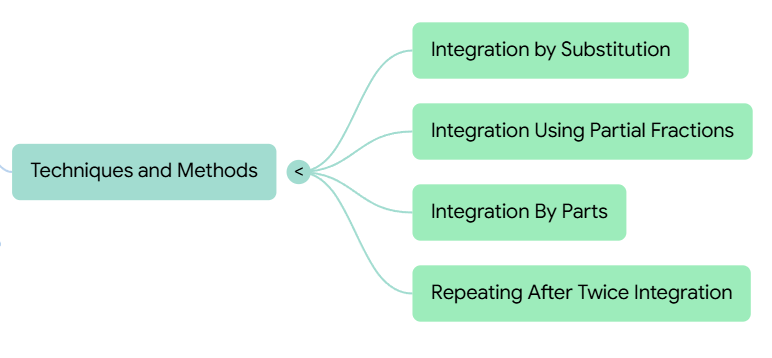
After decomposition, integrate each term separately:
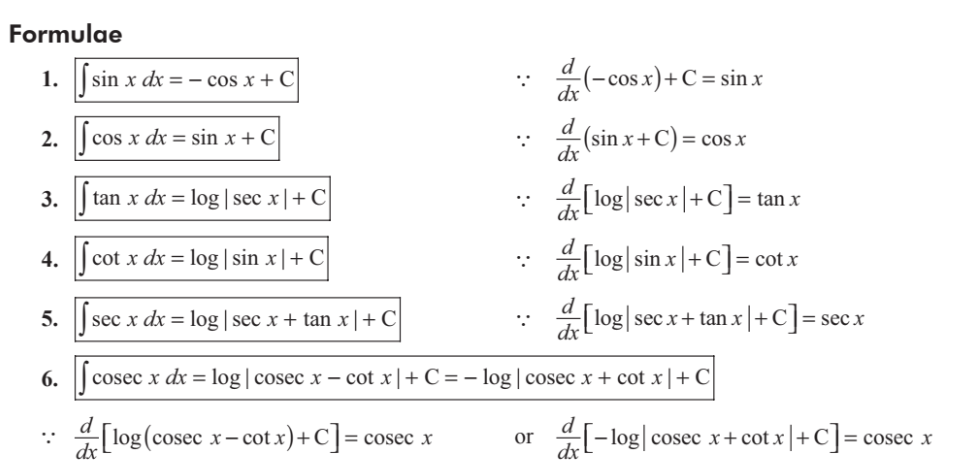
\( \int \frac{A}{x – a} dx = A \ln|x – a| + C \)
\( \int \frac{Bx + C}{x^2 + px + q} dx = \text{Use substitution or arctan form} \)

Video Lecture

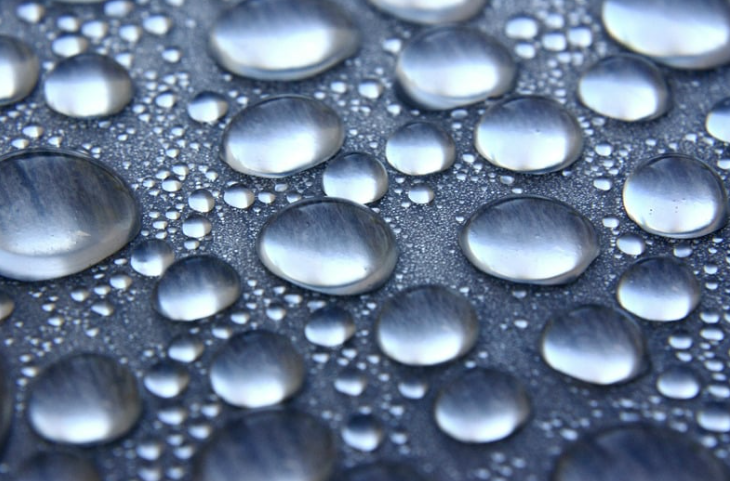
Idea: Molecules at the surface experience a net inward cohesive pull, making the surface behave like a stretched membrane.
Surface tension (also called surface force per unit length) is defined as
$$ T \equiv \frac{F}{L} $$
Surface energy: Work required to increase the surface area by unit amount. In SI, numerical value of surface energy per unit area equals \(T\) (J m\(^{-2}\) ↔ N m\(^{-1}\)).
For a spherical drop of radius \(r\):
$$ \Delta P = \frac{2T}{r} \quad \text{(inside higher than outside)} $$
For a spherical bubble of radius \(r\):
$$ \Delta P = \frac{4T}{r} $$
These follow from mechanical equilibrium of a curved surface under tension.
Capillary rise/fall in a tube of radius \(r\):
$$ h = \frac{2T\cos\theta}{\rho g r} $$
Meniscus: Concave when adhesion \(>\) cohesion (\(\theta<90^\circ\)); convex when cohesion \(>\) adhesion (\(\theta>90^\circ\)).
To create new area \( \Delta A \) at constant \(T\):
$$ W = T\,\Delta A, \qquad \text{so} \quad \frac{dW}{dA} = T. $$
Interpretation: \(T\) is the surface free energy per unit area (isothermal, reversible addition of area).
| Liquid | Approx. \(T\) (N m\(^{-1}\)) | Remarks |
|---|---|---|
| Water | 0.072 | High; strong hydrogen bonding |
| Alcohol (ethanol) | ~0.022 | Lower than water |
| Glycerol | ~0.063 | Viscous, relatively high \(T\) |
| Mercury | ~0.485 | Very high; poor wetting on glass |
| Soap solution | ~0.025–0.040 | Reduced by surfactants |
Values are indicative for classroom use; exact values depend on temperature and purity.
For a bubble of radius \( r = 1.0\,\text{mm} \) with \( T = 0.030\,\mathrm{N\,m^{-1}} \):
$$ \Delta P = \frac{4T}{r} = \frac{4\times 0.030}{1.0\times 10^{-3}} = 120\,\text{Pa}. $$
\( r = 0.50\,\text{mm},\; T = 0.072\,\mathrm{N\,m^{-1}},\; \rho = 1000\,\mathrm{kg\,m^{-3}},\; \theta \approx 0^\circ \):
$$ h = \frac{2T\cos\theta}{\rho g r} = \frac{2 \times 0.072 \times 1}{1000 \times 9.8 \times 0.5\times 10^{-3}} \approx 0.029\,\text{m} \;=\; 2.9\,\text{cm}. $$
© SaitechAI — Prepared for Class 11 learners. You may print or save this page for study use.
Worksheet in Surface Tension, Surface Energy, Capillarity, contact angle, pressure inside the soap bubble.
முனைவர் . எ . இராமநாதன்
மேற்கண்ட வினாக்களுக்கு பதிலளித்துவிட்டு அதன் pdf பிரதியை https://padlet.com/saitech/padlet-9fbndiij8orrdr12
என்ற லிங்கிற்கு அனுப்பவும் . அதற்கான பாஸ் கோடு உங்கள் ஆசிரியரிடம் உள்ளது .
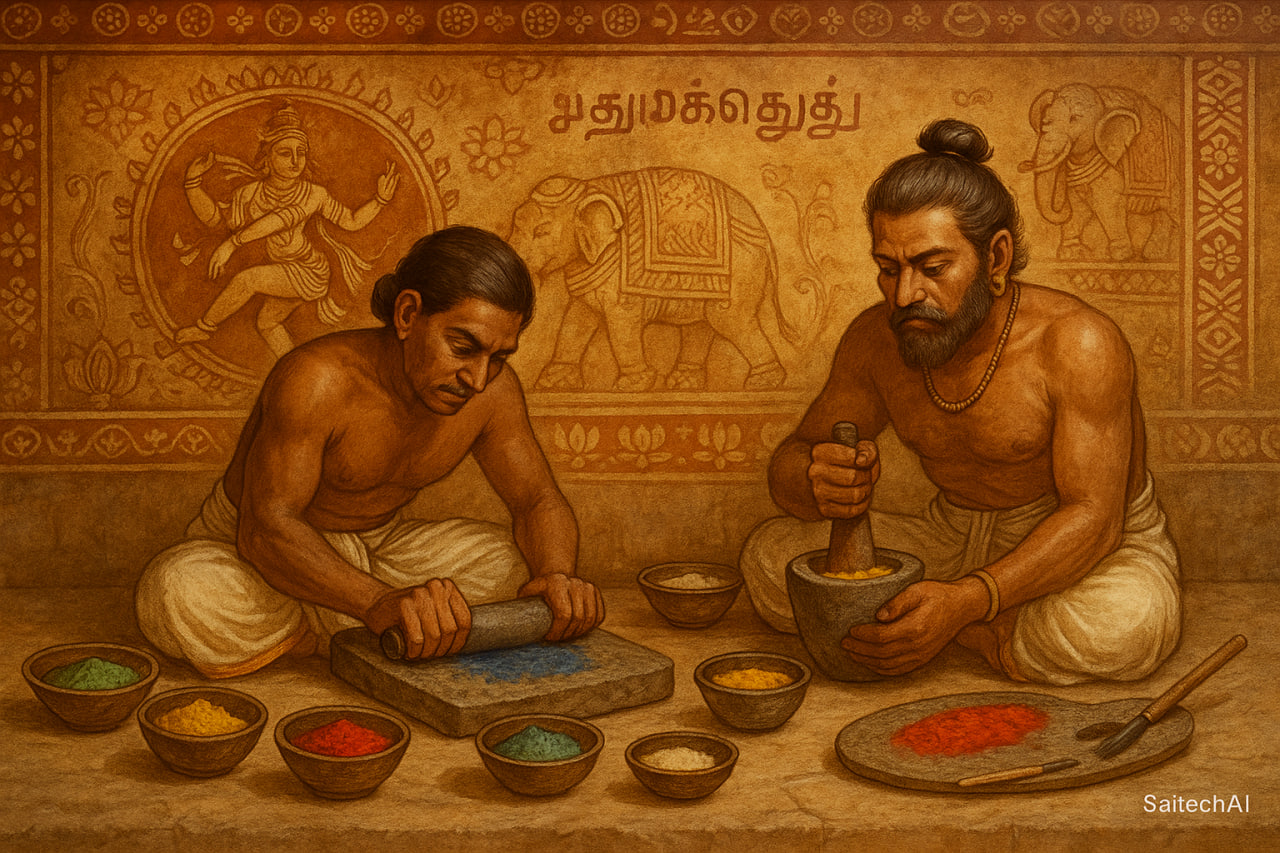
தமிழக வரலாற்று பண்பாட்டில் வேதியியல் முக்கிய பங்கு வகித்துள்ளது. சங்க காலத்திலிருந்தே உலோகவியல், வண்ணப்பூச்சு, மருத்துவம், சுரங்கவியல் ஆகிய துறைகளில் வேதியியல் அறிவு நடைமுறையில் இருந்தது.
தமிழக வரலாற்றில் வேதியியல்:
இவை அனைத்தும் தமிழர் வாழ்வியலோடு கலந்து, உலகளவில் அறிவியல் முன்னேற்றத்தில் பங்களித்துள்ளன.
Dr. E. Ramanathan, PhD (Chemistry)
This paper explores the evolution of chemistry in Tamil Nadu through multiple historical lenses—technology, medicine, art, and trade. Drawing evidence from Sangam literature, archaeological studies, metallurgical analyses of Wootz steel, ethnographic accounts of Siddha medicine, and art-history surveys of temple murals, it argues that Tamil civilization displayed a highly integrative application of chemical knowledge. A comparative perspective demonstrates both continuity with global practices (e.g., metallurgy in China, Islamic alchemy, Greco-Roman dyes) and Tamil Nadu’s unique contributions (e.g., Wootz steel, Navapasanam, organic dye technology).
In Tamil Nadu, chemistry (வேதியியல்) was not an abstract discipline but deeply embedded in everyday life, spanning agriculture, trade, weaponry, religious practice, and medicine. The Sangam corpus (300 BCE–300 CE) provides early poetic evidence of material transformations, while epigraphical records and temple inscriptions (e.g., Brihadeeswara temple, 1010 CE) reveal explicit applications of chemical technology. This continuity illustrates that chemistry was less a laboratory pursuit and more a lived science, transmitted across guilds, artisans, and Siddhars.
Tamil textiles were technological masterpieces. Dye chemistry involved organic compounds with stable chromophores:
Evidence from Roman records (Pliny, Periplus of the Erythraean Sea, 1st CE) shows Tamil-dyed textiles traded globally. Unlike synthetic dyes (post-19th century, Perkin’s mauve), Tamil natural dyes were renewable, eco-friendly, and fast to washing and light.
The Siddha system, attributed to sage Agathiyar and later refined by Bogar and Theraiyar, integrated mineral, metallic, and herbal chemistry.
Comparisons: While Indian Ayurveda also employed metals, Siddha was unique in its emphasis on southern flora and on laboratory-like calcination methods (puttu). Islamic alchemy (Jabir ibn Hayyan) similarly explored metallic elixirs, but Siddha anticipated many concepts of pharmacology with remarkable local adaptations.
The mixture of limestone (CaCO₃), egg white (proteins as binders), and palm juice (organic sugars) acted as a proto-polymer concrete. Raman spectroscopy on temple plasters confirms crystalline calcium carbonate binding with proteinaceous residues, showing remarkable durability (1,000+ years).
Comparisons: Ajanta murals (Maharashtra, 2nd BCE–6th CE) show similar pigments, but Tamil temples innovated by mixing herbal binders (neem oil, plant gums) that prevented fungal growth.
Tamil farmers employed biofertilizers (cow dung → nitrogen, phosphates) and pesticidal decoctions (neem extract). Chola irrigation networks, noted in epigraphy, imply knowledge of water hardness and purification (lime settling tanks). Compared to Egyptian Nile silt farming, Tamil practice was more chemical, actively modifying soil and water chemistry.
Tamil chemical knowledge was not isolated.
Tamil Nadu’s chemical legacy integrates technology (Wootz steel), art (murals, dyes), medicine (Siddha chemistry), agriculture (biofertilizers), and trade (salt, aromatics). Far from being a peripheral craft, this knowledge constituted a holistic applied chemistry, centuries before “modern chemistry” crystallized in Europe. Recognizing Tamil contributions provides continuity to global science history and inspires modern applications in green chemistry, sustainable materials, and heritage science.
உங்களது வாட்ஸாப் கமெண்ட்ஸ் எங்களுக்கு மேலும் ஊக்கத்தை தரவல்லது என்பதை மறவாதீர் .

Modern Periodic Table — Lecture Notes (Class 11, SaitechAI Edition)
| Feature | Periods | Groups |
|---|---|---|
| Number | 7 | 18 |
| Represents | Principal quantum number (n) | Valence shell configuration |
| Example | 2nd period → Li to Ne | Group 17 → Halogens (F, Cl, Br, I, At) |
| Block | Range | Example Elements | Characteristic |
|---|---|---|---|
| s-block | 1–2 | Na, Mg | Highly reactive metals |
| p-block | 13–18 | B, C, N, O, F | Includes nonmetals, metalloids |
| d-block | 3–12 | Fe, Cu, Zn | Transition metals |
| f-block | Lanthanoids, Actinoids | Ce, U | Inner transition metals |

where ( Z ) = atomic number, ( p ) = number of protons, ( n ) = neutrons.
All math on this page renders via MathJax. Use Ctrl/Cmd + P to print or save as PDF.
\[ \log_b(MN)=\log_b M + \log_b N \]
Log of a product equals the sum of logs.
\[ \log_b\!\left(\frac{M}{N}\right)=\log_b M – \log_b N \]
Log of a quotient equals the difference of logs.
\[ \log_b(M^k)=k\,\log_b M \]
Exponent becomes a multiplier.
\[ \log_b\!\big(\sqrt[n]{M}\big)=\frac{1}{n}\,\log_b M \]
An \(n\)-th root is a power of \(\tfrac{1}{n}\).
\[ \log_b(1)=0,\qquad \log_b(b)=1. \]
\[ \log_b(M)=\frac{\log_k(M)}{\log_k(b)} \quad (\text{often } k=10 \text{ or } e). \]
Domains: \(b>0,\; b\neq 1,\; M>0,\; N>0\).
Example A1: \(\log_{10}(2000)\)
\[ \log_{10}(2\times 10^3)=\log_{10}2 + \log_{10}(10^3) = \log_{10}2 + 3 \approx 0.3010 + 3 = 3.3010. \]
Example A2: \(\log_{10}\!\left(\dfrac{50}{2}\right)\)
\[ \log_{10}50 – \log_{10}2 \approx 1.6990 – 0.3010 = 1.3980. \]
Example A3: \(\log_2(32)\)
\[ \log_2(2^5) = 5\,\log_2 2 = 5. \]
Example A4: \(\log_{10}\!\big(\sqrt[3]{1000}\big)\)
\[ \frac{1}{3}\log_{10}(1000)=\frac{1}{3}\cdot 3=1. \]
\[ \log_{3}(20)=\frac{\ln(20)}{\ln(3)} \approx \frac{2.9957}{1.0986}\approx 2.728. \]
Example C1: If \(\log_{10}(N)=2.3010\), then \[ N = \operatorname{antilog}_{10}(2.3010)=10^{2.3010}\approx 200. \]
Example C2: If \(\log_{10}(N)=\overline{1}.4771\) (i.e., \(-1+0.4771\)), then \[ N = 10^{-1+0.4771}=10^{-1}\cdot 10^{0.4771}\approx 0.1\times 3=0.3. \]
| Quantity | Formula / Value | Note |
|---|---|---|
| Definition | \(b^x=N \iff \log_b N = x\) | \(b>0,\; b\neq 1,\; N>0\) |
| Product | \(\log_b(MN)=\log_b M+\log_b N\) | Sum of logs |
| Quotient | \(\log_b\!\left(\dfrac{M}{N}\right)=\log_b M-\log_b N\) | Difference of logs |
| Power | \(\log_b(M^k)=k\,\log_b M\) | Exponent to multiplier |
| Root | \(\log_b(\sqrt[n]{M})=\tfrac{1}{n}\log_b M\) | \(n\in\mathbb{N}\) |
| Change of Base | \(\log_b M=\dfrac{\log_k M}{\log_k b}\) | Use \(k=10\) or \(k=e\) |
| Antilog | \(\operatorname{antilog}_b(x)=b^x\) | Inverse of \(\log_b\) |

Developed by Dr E. Ramanathan
Target Audience: High School, Higher Secondary Students, NEET-JEE Aspirants, Chemists, Engineers, Operators from Surface Coating Technology Field.
| Term | Definition / Formula | Units |
|---|---|---|
| Weight/Weight % (w/w%) | \(\%w/w = \dfrac{w_2}{W}\times 100\) | % (g solute per 100 g solution) |
| Weight/Volume % (w/v%) | \(\%w/v = \dfrac{w_2}{V}\times 100\) | % (g solute per 100 mL solution) |
| Volume/Volume % (v/v%) | \(\%v/v = \dfrac{V_2}{V}\times 100\) | % (mL solute per 100 mL solution) |
| Molarity (M) | \(M = \dfrac{n_2}{V} = \dfrac{w_2}{M_2 \cdot V}\) | mol·L⁻¹ |
| Molality (m) | \(m = \dfrac{n_2}{w_1(\mathrm{kg})} = \dfrac{w_2}{M_2 \cdot w_1(\mathrm{kg})}\) | mol·kg⁻¹ |
| Normality (N) | \(N = \dfrac{eq_2}{V} = \dfrac{w_2}{\text{GEW}_2 \cdot V}, \ \text{GEW}_2 = \dfrac{M_2}{e}\) | eq·L⁻¹ |
| Mole Fraction (\(x_2\)) | \(x_2 = \dfrac{n_2}{n_1+n_2}\) | Dimensionless |
| Parts per million (ppm) | \(\text{ppm} = \dfrac{w_2}{W}\times 10^6\) For aqueous solutions: \(1 \ \text{mg·L}^{-1} \approx 1 \ \text{ppm}\) |
ppm (mg·L⁻¹) |
Symbols: \(w_2\) = solute mass (g), \(w_1\) = solvent mass (g or kg), \(W = w_1+w_2\) = solution mass, \(V\) = solution volume (L), \(V_2\) = solute volume, \(M_2\) = molar mass of solute (g·mol⁻¹), \(e\) = equivalence factor.
Unless stated otherwise: masses in grams, volumes in litres (L) for molarity, and kilograms (kg) for molality denominator.
\[ M \;=\; \frac{n_2}{V}\;=\;\frac{w_2/M_2}{V}\quad\text{(mol L}^{-1}\text{)} \]
\[ N \;=\; \frac{\text{equivalents of solute}}{V} \;=\; \frac{eq_2}{V},\qquad eq_2 \;=\; \frac{w_2}{\text{GEW}_2} \]
\[ \text{GEW}_2 \;=\; \frac{M_2}{e} \] where \(e\) is the valence (equivalence) factor determined by the reaction context (acid–base, redox, precipitation, etc.).
| Solute (typical context) | \(e\) | Notes |
|---|---|---|
| \(\mathrm{HCl}\), \(\mathrm{NaOH}\) (acid–base) | 1 | Monoprotic acid / monobasic base |
| \(\mathrm{H_2SO_4}\) (acid–base) | 2 | Diprotic acid (can donate 2 H\(^+\)) |
| \(\mathrm{CaSO_4}\) (precipitation/ionic) | 2 | In ionic reactions, \(e\) equals total charge change per mole participating |
Defined per kilogram of solvent (not solution).
\[ m \;=\; \frac{n_2}{\;w_1\;(\mathrm{kg})}\;=\;\frac{w_2/M_2}{w_1(\mathrm{kg})}\quad\text{(mol kg}^{-1}\text{)} \]
Sum of all mole fractions equals 1.
\[ x_2 \;=\; \frac{n_2}{n_1+n_2},\qquad x_1 \;=\; \frac{n_1}{n_1+n_2},\qquad x_1+x_2=1 \]
| Quantity | Primary Formula | Common Rearrangement |
|---|---|---|
| Molarity, \(M\) | \(M=\dfrac{n_2}{V}\) | \(M=\dfrac{w_2}{M_2\,V}\) |
| Normality, \(N\) | \(N=\dfrac{eq_2}{V}\) | \(N=\dfrac{w_2}{\text{GEW}_2\,V}\) |
| Molality, \(m\) | \(m=\dfrac{n_2}{w_1(\mathrm{kg})}\) | \(m=\dfrac{w_2}{M_2\,w_1(\mathrm{kg})}\) |
| Mole fraction, \(x_2\) | \(x_2=\dfrac{n_2}{n_1+n_2}\) | \(x_1=\dfrac{n_1}{n_1+n_2}\) |
| w/w% | \(\dfrac{w_2}{W}\times 100\) | — |
| w/v% | \(\dfrac{w_2}{V}\times 100\) | — |
| v/v% | \(\dfrac{V_2}{V}\times 100\) | — |
| ppm (mass) | \(\dfrac{w_2}{W}\times 10^{6}\) | \(\approx\dfrac{\text{mg}}{\text{L}}\) (aqueous) |
Always specify temperature and density assumptions when converting between mass- and volume-based measures.

Physics – Work, Energy & Power (Chapter view) → Split into Concepts:
Instead of rushing the chapter in 3–4 sessions, each concept is taught, practiced, and tested individually.
✅ Outcome:
You are absolutely right — chapter-wise coaching is not the ideal model for competitive exams like NEET and JEE.
✅ Result: Students become concept-strong, not just chapter-complete. This modular strength ensures no blind spots in exams.

✅ Final Thought:
Just like an army trained on drone tactics can dominate the battlefield, a student trained concept-wise can dominate JEE/NEET papers — because concepts, once mastered, can be deployed flexibly against any problem.

Class 12, Physics, Electromagnetic Induction
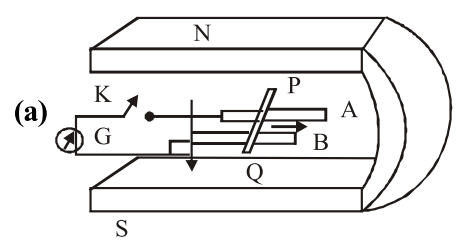
Figure shows a metal rod PQ resting on the smooth rails AB and positioned between the poles of a permanent magnet. The rails, the rod, and the magnetic field are in three mutual perpendicular directions. A galvanometer G connects the rails through a switch K.

Length of the rod = 15 cm,
B = 0.50 T,
resistance of the closed loop containing the rod = 9.0 mΩ.
Assume the field to be uniform.
Suppose K is open and the rod is moved with a speed of 12 cm s⁻¹ in the direction shown. Give the polarity and magnitude of the induced emf.
(b) Is there an excess charges built up at the ends of the rods when K is open? What if K is closed?
(c) With K open and the rod moving uniformly, there is no net force on the electrons in the rod PQ even though they do experience magnetic force due to the motion of the rod. Explain.
(d) What is the retarding force on the rod when K is closed?
(e) How much power is required (by an external agent) to keep the rod moving at the same speed (= 12 cm s⁻¹) when K is closed? How much power is required when K is open?
(f) How much power is dissipated as heat in the closed circuit? What is the source of this power?
(g) What is the induced emf in the moving rod if the magnetic field is parallel to the rails instead of being perpendicular?
Given Data: Length of rod \(L = 15 \,\text{cm} = 0.15 \,\text{m}\), Magnetic field \(B = 0.50 \,\text{T}\), Speed \(v = 12 \,\text{cm/s} = 0.12 \,\text{m/s}\), Resistance \(R = 9.0 \,\text{m}\Omega = 9.0 \times 10^{-3}\,\Omega\).
The setup of the problem is shown below:

\(\varepsilon = B L v = 0.50 \times 0.15 \times 0.12 = 9.0 \times 10^{-3}\,\text{V} = 9\,\text{mV}\)
Polarity: P positive, Q negative.
K open: Excess charges accumulate at rod ends until induced electric field cancels the magnetic force.
K closed: No sustained charge build-up; charges drift continuously as current flows.
Magnetic force: \(F_B = q(\mathbf{v} \times \mathbf{B})\). Electric force from charges: \(F_E = qE\). At equilibrium, \(F_B + F_E = 0\). Hence, net force = 0.
Current: \(I = \dfrac{\varepsilon}{R} = \dfrac{B L v}{R}\)
Force: \(F = I L B = \dfrac{B^{2} L^{2} v}{R}\)
\(F = \dfrac{0.50^{2} \times 0.15^{2} \times 0.12}{9 \times 10^{-3}} = 0.075 \,\text{N}\)
\(P = F v = \dfrac{B^{2} L^{2} v^{2}}{R} = 0.009 \,\text{W} = 9 \,\text{mW}\)
K open: \(P = 0\) (no current flows).
\(P_{\text{heat}} = I^{2} R = \dfrac{\varepsilon^{2}}{R} = 0.009 \,\text{W}\)
Source: Mechanical work done by external agent moving the rod.
\(\varepsilon = B L v \sin\theta\)
For \(\theta = 0^\circ\), \(\sin 0 = 0 \implies \varepsilon = 0\).