Posted on Leave a comment

Electromagnetic induction formula worksheet

SaitechAI Worksheet – Electromagnetic Induction Formulae

SaitechAI Worksheet

Important Formulae – Electromagnetic Induction

Q1. State Faraday’s law of electromagnetic induction and write its formula.
ε = dφ/dt, where ε = induced emf. (Faraday’s Law)
Q2. Derive the expression for motional emf in a conductor.
ε = – B l v (Motional emf)
Q3. Find the emf developed between the ends of a rod rotating in a magnetic field.
V = ½ B ω l²
Q4. State the relation between magnetic flux and inductance.
φ = L I
Q5. Write the expression for self-induced emf in a coil.
ε = – L dI/dt
Q6. Define mutual inductance and give its formula.
ε₁ = – M₁₂ dI₂/dt
Q7. Derive the expression for self-inductance of a solenoid.
L = μr μ0 n² A l
Q8. State the emf equation of an AC generator.
e = nBAω sin ωt (ω = 2πv)
Q9. Write the expression for energy stored in an inductor.
U = ½ L I²
Total Marks: 0/20
Posted on Leave a comment

Saitechinfo Family Board

To ensure there is no communication gap between students, parents, and faculty, SaitechAI will treat the learning process as a collaborative task. Every stage of learning will be tracked and displayed in the Saitech Family Board for transparency. Each parent will be given access code to watch the live academic board.

Saitech Learning Stages – To Be Maintained by Every Student for Each Topic

  1. Flash Card Preparation
    • Topic tree
    • Terms and definitions
    • Symbols and expressions
    • Formulae and equations
    • Units and dimensions
    • Constant values
    • Tables and figures
  2. Sparknotes – concise key points for quick revision.
  3. Guided Problems – solved examples and textbook problems.
  4. Target Problems – daily practice of 6 problems within 45 minutes.
  5. Worksheets – structured practice assignments.
  6. Centum Cyclic Unit Tests – periodic tests for mastering accuracy.
  7. Failure Mode Analysis – identifying mistakes in school tests and documenting corrective measures.
  8. Model Examinations – simulated exams to prepare for real assessments.
  9. Academic Performance Presentations – students present their progress, learning gaps, and improvements.

This system ensures continuous monitoring, accountability, and collaboration—helping students stay disciplined, parents stay informed, and teachers stay aligned.

– SaitechAI

Posted on Leave a comment

Electronic configuration worksheet

SaitechAI Worksheet — Electronic Configuration (Block Elements)

SaitechAI Worksheet — Electronic Configuration

10 problems from p-block, d-block and f-block elements

Start: End: Duration:
Q1. Boron (Z = 5, p-block)
1s² 2s² 2p¹
Q2. Nitrogen (Z = 7, p-block)
1s² 2s² 2p³
Q3. Sulfur (Z = 16, p-block)
1s² 2s² 2p⁶ 3s² 3p⁴
Q4. Bromine (Z = 35, p-block)
[Ar] 3d¹⁰ 4s² 4p⁵
Q5. Copper (Z = 29, d-block)
[Ar] 3d¹⁰ 4s¹
Q6. Zinc (Z = 30, d-block)
[Ar] 3d¹⁰ 4s²
Q7. Iron (Z = 26, d-block)
[Ar] 3d⁶ 4s²
Q8. Cerium (Z = 58, f-block)
[Xe] 4f¹ 5d¹ 6s²
Q9. Neodymium (Z = 60, f-block)
[Xe] 4f⁴ 6s²
Q10. Uranium (Z = 92, f-block)
[Rn] 5f³ 6d¹ 7s²
Score: 0/20
Blocks covered: p-block (Q1–Q4), d-block (Q5–Q7), f-block (Q8–Q10). © SaitechAI
Posted on Leave a comment

Formal Charges Worksheet

SaitechAI Worksheet – Formal Charges

SaitechAI Worksheet – Formal Charges in Chemistry

Name: Class: Roll No:
1. Calculate the formal charge of oxygen in the hydroxide ion (OH⁻).
Show/Hide Key
Key: O has 6 valence e⁻; nonbonding=6, bonding=2 → FC = 6 – 6 – (2/2) = -1.
Award 2 marks
2. Find the formal charge of nitrogen in ammonium ion (NH₄⁺).
Show/Hide Key
Key: N valence=5; nonbonding=0, bonding=8 → FC=5 – 0 – (8/2) = +1.
Award 2 marks
3. Calculate the formal charge on central C atom in CO₂.
Show/Hide Key
Key: C valence=4; nonbonding=0; bonding=8 → FC=4 – 0 – 4=0.
Award 2 marks
4. Find formal charge of oxygen in H₃O⁺ ion.
Show/Hide Key
Key: O valence=6; nonbonding=2; bonding=6 → FC=6 – 2 – 3=+1.
Award 2 marks
5. Find formal charge of each O in O₃ (ozone).
Show/Hide Key
Key: Resonance forms → terminal O: -1 and 0; central O: +1.
Award 2 marks
6. Calculate formal charge of nitrogen in NO₃⁻ ion.
Show/Hide Key
Key: N valence=5; nonbonding=0; bonding=8 → FC=5 – 0 – 4=+1.
Award 2 marks
7. Calculate formal charge of chlorine in ClO₄⁻ ion.
Show/Hide Key
Key: Cl valence=7; bonding=8; FC=7 – 0 – 4=+3 (resonance spread).
Award 2 marks
8. Find formal charge of carbon in CN⁻ ion.
Show/Hide Key
Key: C valence=4; nonbonding=2; bonding=6 → FC=4 – 2 – 3=-1.
Award 2 marks
9. Find formal charge of nitrogen in NO₂⁻ ion.
Show/Hide Key
Key: N valence=5; bonding=7; nonbonding=0 → FC=5 – 0 – 3.5=+1.5 (delocalized).
Award 2 marks
10. Calculate formal charge of phosphorus in phosphate ion (PO₄³⁻).
Show/Hide Key
Key: P valence=5; bonding=8; nonbonding=0 → FC=5 – 0 – 4=+1.
Award 2 marks
Total Score: 0 / 20
Posted on Leave a comment

Python Short Programs Worksheets

SaitechAI • Python Programming Worksheet (Weighted Marks)
SaitechAI • Worksheet

Python Programming Worksheet — 10 Short Questions

Write your script in the box for each question. Tick “Correct” after verification. Use Show Key to reveal solutions. Weighted total: 20 marks.

Q1. Print the first 10 natural numbers using a loop.
Print numbers 1 to 10 on one line separated by spaces.
Key:
for i in range(1,11):
    print(i, end=" ")
Q2. Function to check if a number is even or odd.
Key:
def is_even(n: int) -> bool:
    return n % 2 == 0
Q3. Largest number in a list (no max()).
Key:
nums = [12, 4, 29, 7, -1]
m = nums[0]
for x in nums[1:]:
    if x > m:
        m = x
print(m)
Q4. Factorial using recursion with base cases 0 and 1.
Key:
def fact(n: int) -> int:
    return 1 if n <= 1 else n * fact(n-1)
Q5. Reverse a string input by the user.
Key:
s = input().strip()
print(s[::-1])
Q6. Multiplication table of a number up to 10.
Key:
n = int(input())
for i in range(1, 11):
    print(f"{n} x {i} = {n*i}")
Q7. Palindrome check ignoring case and spaces.
Key:
t = ''.join(ch.lower() for ch in input() if not ch.isspace())
print("Palindrome" if t == t[::-1] else "Not palindrome")
Q8. Count vowels (a, e, i, o, u) in a string.
Key:
s = input().lower()
print(sum(ch in "aeiou" for ch in s))
Q9. Swap two variables without using a third variable.
Key:
a, b = 5, 9
a, b = b, a
print(a, b)
Q10. Sum of all elements in a list read from a line of input.
Key:
nums = list(map(int, input().split()))
total = 0
for x in nums:
    total += x
print(total)
Total Score: 0 / 20
Posted on Leave a comment

pH and pOH Worksheet

SaitechAI

pH & pOH – 15 Problems Worksheet

Enter answers with 2–3 significant digits unless stated.

Score: 0 / 15
Answer Key & Explanations (Hidden)

Rounding: Unless specified, give answers to 2 decimal places. Use 25 °C (Kw = 1.0×10⁻¹⁴).

© SaitechAI – Worksheet Card Style

Posted on Leave a comment

Log and antilog Worksheets

Student should work out these worksheets in their notebook and enter the answers online. Get them corrected. Print the score as pdf and send it to the faculty.

Decimal Operations Worksheet — Multiplication • Division • Powers • Roots
SaitechAI
Enter answers → click Check Answers for instant corrections & score. Reveal full key only after solving.
Multiplication0/6
Division0/6
Powers0/6
Roots0/6
Total0/24

Multiplication (6 problems)

    Division (6 problems)

      Powers (6 problems)

        Roots (6 problems)

          © SaitechAI • Auto-correction with tolerance ±0.001; hidden key for verification.

          Use the Log and antilog calculator

          Posted on Leave a comment

          Logarithm practice Worksheet

          Logarithm Worksheet – SaitechAI Topic Card

          SaitechAI Worksheet: Logarithm to Base 10 using Log Table

          Instruction: Use the logarithm table to find the values of the following logarithms. Round answers to 4 decimal places.
          Q1. log10(2.345)
          Q2. log10(0.0547)
          Q3. log10(18.92)
          Q4. log10(245.6)
          Q5. log10(6.022 × 10²³)
          Q6. log10(3.16 × 10⁻⁴)
          Q7. log10(√25)
          Q8. log10(√0.0081)
          Q9. log10(7.772)
          Q10. log10(0.000347)
          Q11. log10(5.5 × 10⁷)
          Q12. log10(9.81 × 10⁻²)

          Answer Key

          Q1. log10(2.345) ≈ 0.3707
          Q2. log10(0.0547) ≈ -1.2619
          Q3. log10(18.92) ≈ 1.2765
          Q4. log10(245.6) ≈ 2.3908
          Q5. log10(6.022 × 10²³) ≈ 23.7796
          Q6. log10(3.16 × 10⁻⁴) ≈ -3.5004
          Q7. log10(√25) = log10(5) ≈ 0.6990
          Q8. log10(√0.0081) = log10(0.09) ≈ -1.0458
          Q9. log10(7.772) = 2 log10(7.77) ≈ 1.7791
          Q10. log10(0.000347) ≈ -3.4597
          Q11. log10(5.5 × 10⁷) ≈ 7.7404
          Q12. log10(9.81 × 10⁻²) ≈ -1.0086
          Posted on Leave a comment

          Lewis Dot Structure Worksheet

          Lewis Dot Symbols – 10 Q&A (SaitechAI Topic Card)

          Lewis Dot Symbols – Worksheet (10 Questions & Answers)

          Topic Card • Chemistry • Chemical Bonding Subtopic: Lewis Symbols (Valence Electrons) © SaitechAI
          SaitechAI
          SaitechAI • Topic Card
          Posted on Leave a comment

          Covalent Bond

          Chapter: Chemical Bonding, Class 11

          Study Notes

          Covalent Bond

          Covalent Bond – SaitechAI Topic Card
          SaitechAI

          Covalent Bond – Lecture Notes

          Class 11 | Chemistry

          Definition
          A covalent bond is sharing of electrons between atoms to achieve stable electronic configuration.
          Types
          Single, Double, Triple, Coordinate covalent bond.
          Characteristics
          Usually low melting and boiling points (except network solids), poor electrical conductivity, often soluble in non-polar solvents.
          Classification based on Electronegativity
          Non-polar covalent bond → negligible ΔEN (e.g., H₂, Cl₂, O₂).
          Polar covalent bond → moderate ΔEN with partial charges (e.g., HCl, H₂O, NH₃).
          Lewis Representation of Simple Molecules
          Dot-and-cross structures for shared pairs (e.g., H₂O: two bonding pairs + two lone pairs on O).

          Variable Covalency and Its Reason
          Elements with vacant d-orbitals (P, S, Cl) can expand their octet and show multiple valencies (PCl₃ vs PCl₅, SF₆).
          Formal Charge
          FC = (Valence e⁻) − (Nonbonding e⁻ + ½ × Bonding e⁻); helps identify the most stable resonance structure.
          Bond Parameters
          Bond length → Triple < Double < Single.
          Bond angle → CH₄ (109.5°) > NH₃ (107°) > H₂O (104.5°).
          Bond enthalpy → Triple > Double > Single.
          Bond order → Higher order means stronger, shorter bonds; resonance gives fractional.
          Limitations of Octet Rule / Deviations
          Incomplete octet (BeCl₂, BF₃).
          Expanded octet (SF₆, PCl₅).
          Odd-electron species (NO, NO₂).
          Hypervalent / hypovalent molecules.
          © SaitechAI • For academic use
          Posted on Leave a comment

          Lewis Structure

          Study Notes

          1. Introduction to Lewis Structures

          • Developed by Gilbert N. Lewis (1916) to represent covalent bonding.
          • Also called electron dot structures.
          • Show valence electrons as dots and bond pairs as lines.
          • Help predict molecular shape, polarity, and reactivity.

          2. Basic Rules

          Check formal charge to find the most stable structure.

          Count valence electrons of all atoms.

          Arrange atoms: the least electronegative atom is usually central (except H).

          Form bonds by pairing electrons between atoms.

          Complete octets of outer atoms first, then central atom.

          Use multiple bonds (double/triple) if needed to satisfy octet.

          Video Lecture – Playlist


          3. Formal Charge Formula

          • Lower formal charges = more stable.
          • Negative charge should reside on more electronegative atoms.

          4. Examples

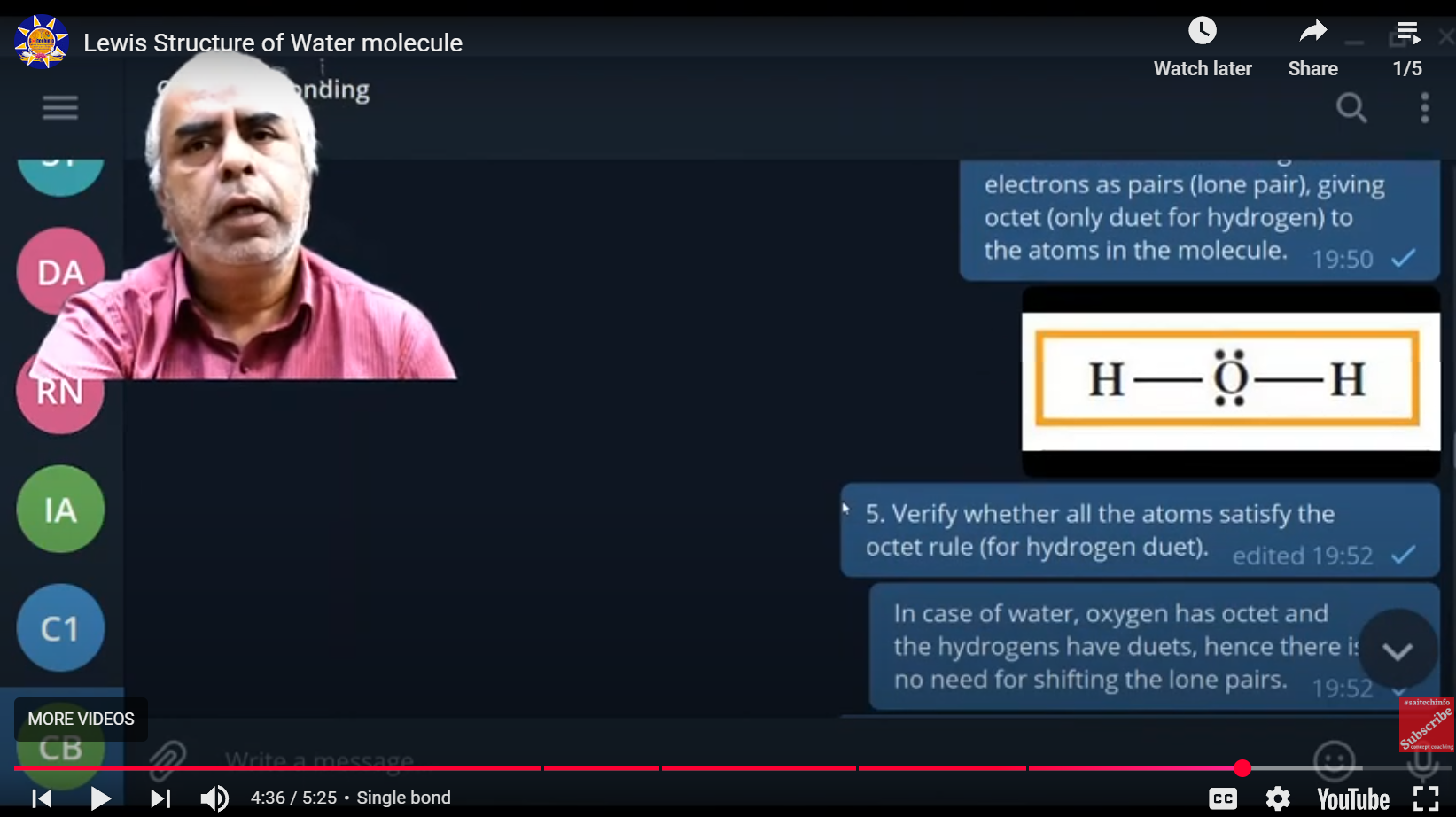
          • Water (H₂O): O is central, 2 lone pairs, 2 bonds with H.
          • CO₂: C in center, 2 double bonds with O, no lone pairs on C.
          • Ozone (O₃): Resonance structure with one double and one single bond, formal charges adjusted.
          • Ammonium ion (NH₄⁺): 4 bonds around N, no lone pair, positive charge.

          5. Resonance

          • Occurs when more than one valid structure exists.
          • Real structure = hybrid of resonance forms.
          • Example: Benzene (C₆H₆), O₃.

          6. Limitations

          • Does not show 3D geometry (use VSEPR theory).
          • Cannot explain delocalization completely (needs MO theory).
          • Fails for some transition metal complexes.

          7. Importance

          • Foundation for VSEPR theory (shapes).
          • Useful in predicting reactivity sites in organic chemistry.
          • Basis for acid-base theories (Lewis acids/bases).

          Key Terms in Lewis Structure

          1. Valence-Electrons – Electrons in the outermost shell that participate in bonding.
          2. Electron-Dot-Structure – Representation of atoms showing valence electrons as dots.
          3. Bonding-Pair – A pair of electrons shared between two atoms forming a covalent bond.
          4. Lone-Pair – A pair of valence electrons not involved in bonding.
          5. Central-Atom – The least electronegative atom (except hydrogen) placed at the center of a Lewis structure.
          6. Octet-Rule – Atoms tend to achieve eight electrons in their valence shell for stability.
          7. Duet-Rule – Hydrogen attains stability with only two valence electrons.
          8. Double-Bond – Two shared pairs of electrons between the same two atoms.
          9. Triple-Bond – Three shared pairs of electrons between the same two atoms.
          10. Formal-Charge – Hypothetical charge calculated by assuming equal sharing of bonding electrons.
          11. Resonance-Structure – Different valid electron arrangements for the same molecule.
          12. Charge-Delocalization – Distribution of electron density across multiple atoms due to resonance.
          13. Expanded-Octet – Central atom holding more than eight electrons, possible in period 3 and beyond.
          14. Incomplete-Octet – Central atom with fewer than eight electrons, common in Be and B compounds.
          15. Lewis-Acid – Species that accepts an electron pair to form a bond.

          Activities

          Online MCQ Test