Posted on Leave a comment

Ohm’s Law Worksheet

Lecture Notes on Ohm’s Law

*(Prepared by SaitechAI)


1. Introduction

  • Ohm’s Law is a fundamental principle in electrical circuits.
  • Proposed by Georg Simon Ohm (1827).
  • It defines the relationship between voltage (V), current (I), and resistance (R).

2. Statement of Ohm’s Law

At constant temperature, the current (I) flowing through a conductor is directly proportional to the potential difference (V) across its ends, provided the physical conditions remain constant.

Mathematically: V=I×RV = I \times R


3. Key Terms

  1. Voltage (V)
    • Also called potential difference.
    • Unit: Volt (V).
    • Measured by a voltmeter (connected in parallel).
  2. Current (I)
    • Flow of electric charge per unit time.
    • Unit: Ampere (A).
    • Measured by an ammeter (connected in series).
  3. Resistance (R)
    • Opposition offered by the conductor to the flow of current.
    • Unit: Ohm (Ω).
    • Depends on material, length, area of cross-section, and temperature.

4. Graphical Representation

  • I–V characteristics of an ohmic conductor:
    • A straight line passing through the origin.
    • Slope = VI=R\frac{V}{I} = R.
  • For non-ohmic devices (e.g., filament lamps, diodes), the I–V graph is nonlinear.

5. Conditions for Validity

  • Temperature should remain constant.
  • Physical properties of the conductor (dimensions, material) must not change.
  • Fails in semiconductors, vacuum tubes, electrolytes.

6. Applications

  1. Designing and analyzing electrical circuits.
  2. Measuring resistance of unknown devices using Ohm’s law method.
  3. Used in domestic wiring, electrical appliances, and power distribution.
  4. Forms the basis of electronic circuit analysis.

7. Example Problems


8. Important Points

  • Ohm’s Law helps in understanding linear circuits.
  • Resistance varies with temperature for metals (increases as temperature increases).
  • Used in combination with Kirchhoff’s Laws for circuit analysis.

9. Summary

  • Formula: V = IR
  • V∝IV \propto I when RR is constant.
  • Applicable for ohmic conductors under constant physical conditions.

Ohm’s Law Worksheet:

Please enter the details, once finished take a print pdf and submit to the faculty.

Ohm’s Law (V = I × R) — Worksheet

Name: Class: Date: Duration: 00:00:00
Posted on Leave a comment

Cellular Respirations

Concept Card / Doubt Card

Q: 11 (a) What is cellular respiration? During cellular respiration, the complete oxidation of one molecule of glucose (C₆H₁₂O₆) releases approximately 38 ATP molecules. If a cell metabolizes 5 molecules of glucose, how many ATP molecules are produced?


Step-by-Step Explanation (Std 10 NCERT Science)

1. Definition of Cellular Respiration
Cellular respiration is the biological process in which cells break down glucose (food molecules) in the presence of oxygen to release energy in the form of ATP (adenosine triphosphate).

Equation:

2. ATP Yield per Glucose

  • In aerobic respiration (complete oxidation), 1 molecule of glucose releases ~38 ATP molecules.
    These ATP molecules are the “energy currency” of the cell.

3. For 5 molecules of glucose

  • If 1 glucose → 38 ATP
  • Then 5 glucose → 5×38=190 ATP5 \times 38 = 190 ATP

4. Final Answer
A cell metabolizing 5 molecules of glucose will produce approximately: 190  ATP  molecules\mathbf{190 \; ATP \; molecules}


Answer: Cellular respiration is the process of breaking down glucose in cells to release energy in the form of ATP. From 5 glucose molecules, about 190 ATP molecules are produced.

SaitechAI

Posted on Leave a comment

Gift Card Generator

For Successful Saitechies on Weekly Basis

Saitechies Gift Points Card Saitechinfo NEET • JEE • CBSE Academy — Powered by SaitechAI


S.No Criteria Achieved Points (per tick)
1 100% Attendance (Mon–Sat) 0
2 18 Flashcards completed in the week 0
3 36 Target Questions in the week 0
4 54 Guided Problems in the week 0
5 2 Centum Cyclic Unit Tests in the week 0
Total Points (out of 100) 0
Percentage 0%
Tick the achieved boxes to compute points.
Short Note: Gift points earned can be used only for purchasing the cards available in Saitechinfo Digital Stores and can neither be encashed nor be adjusted in the regular fees.
Learn consistently. Earn Points. Redeem Knowledge.
Redemption: Topic Cards, Concept Cards, Doubt Cards, Question Bank Cards, and select Gift Articles from our digital stores.
Redemption Eligibility: 100% total gift points (weekly basis only).
© Saitechinfo | SaitechAI
Posted on Leave a comment

Language Policy at Saitechinfo

At Saitechinfo, we firmly believe that learning in the mother tongue ensures deeper understanding and better retention of knowledge. To achieve this, we follow a bilingual system of coaching:

  1. English with Mother Tongue Support
    • Core explanations are delivered in English.
    • Parallel reinforcement is provided in students’ mother tongue (Tamil/Hindi), ensuring clarity in basic concepts.
  2. Pure English Coaching
    • For students aiming at higher academic and professional standards, we also provide sessions fully in English, enabling them to strengthen technical vocabulary and communication.
  3. Faculty Voice Translation
    • Original lectures delivered by our faculty members are translated into Hindi and Tamil along with English.
    • This makes our video lectures more accessible, helping students bridge gaps in comprehension.
  4. Clarity in Basic Concepts
    • With this bilingual support, students gain confidence in both conceptual understanding and technical terminology.
    • This balance prepares them for competitive exams, academic success, and real-world applications.

In essence: Saitechinfo nurtures students by blending mother tongue for clarity with English for technical excellence, ensuring every learner gets the best of both worlds.

Posted on Leave a comment

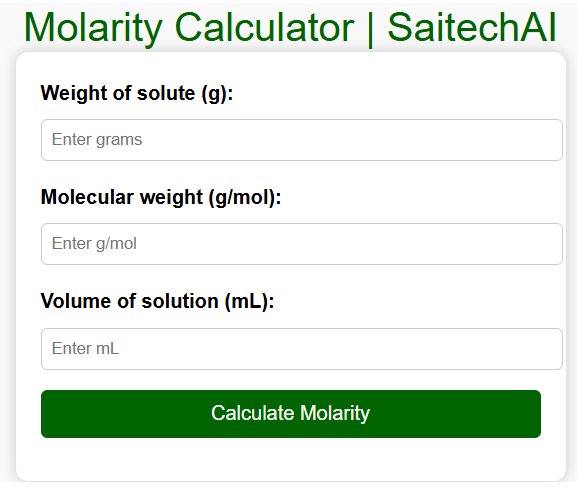
Molarity Calculator

Chemistry

Molarity = number of moles per litre

Unit of molarity = moles per litre (mol/L)

Molarity Calculator | SaitechAI

Molarity Calculator | SaitechAI

html + javascript for molarity calculator

Practice coding:

<!DOCTYPE html>
<html lang="en">
<head>
  <meta charset="UTF-8">
  <meta name="viewport" content="width=device-width, initial-scale=1.0">
  <title>Molarity Calculator | SaitechAI</title>
  <style>
    body {
      font-family: Arial, sans-serif;
      margin: 30px;
      background: #f9f9f9;
    }
    h2 {
      color: #006400;
      text-align: center;
    }
    .calculator {
      max-width: 400px;
      margin: auto;
      padding: 20px;
      background: white;
      border-radius: 10px;
      box-shadow: 0 0 10px rgba(0,0,0,0.2);
    }
    label {
      font-weight: bold;
    }
    input {
      width: 100%;
      padding: 8px;
      margin: 8px 0 16px 0;
      border: 1px solid #ccc;
      border-radius: 5px;
    }
    button {
      background-color: #006400;
      color: white;
      padding: 10px;
      border: none;
      border-radius: 5px;
      cursor: pointer;
      width: 100%;
      font-size: 16px;
    }
    button:hover {
      background-color: #004d00;
    }
    #result {
      margin-top: 15px;
      font-weight: bold;
      text-align: center;
      color: #333;
    }
  </style>
</head>
<body>

  <h2>Molarity Calculator | SaitechAI</h2>
  <div class="calculator">
    <label for="weight">Weight of solute (g):</label>
    <input type="number" id="weight" step="0.01" placeholder="Enter grams">

    <label for="mol_weight">Molecular weight (g/mol):</label>
    <input type="number" id="mol_weight" step="0.01" placeholder="Enter g/mol">

    <label for="volume">Volume of solution (mL):</label>
    <input type="number" id="volume" step="0.01" placeholder="Enter mL">

    <button onclick="calculateMolarity()">Calculate Molarity</button>

    <div id="result"></div>
  </div>

  <script>
    function calculateMolarity() {
      let weight = parseFloat(document.getElementById('weight').value);
      let molWeight = parseFloat(document.getElementById('mol_weight').value);
      let volume = parseFloat(document.getElementById('volume').value);

      if (isNaN(weight) || isNaN(molWeight) || isNaN(volume) || molWeight <= 0 || volume <= 0) {
        document.getElementById('result').innerHTML = "⚠️ Please enter valid numbers.";
        return;
      }

      let moles = weight / molWeight;
      let volumeLiters = volume / 1000;
      let molarity = moles / volumeLiters;

      document.getElementById('result').innerHTML = 
        "Molarity of the solution = <b>" + molarity.toFixed(4) + " mol/L</b>";
    }
  </script>

</body>
</html>

Python code

def calculate_molarity(weight_solute, mol_weight, volume_ml):
    moles = weight_solute / mol_weight
    volume_liters = volume_ml / 1000
    molarity = moles / volume_liters
    return molarity

weight = float(input("Enter weight of solute (g): "))
mol_weight = float(input("Enter molecular weight of solute (g/mol): "))
volume = float(input("Enter volume of solution (mL): "))

M = calculate_molarity(weight, mol_weight, volume)
print(f"Molarity of the solution = {M:.4f} mol/L")

Molarity Calculator developed using Python

Powered by SaitechAI

Posted on Leave a comment

Saitechinfo Gurukulam Gift Points


🎁 Saitechinfo Gurukulam · Gift Points

Earn Weekly & Monthly Gift Points

Consistency pays off. Redeem points at Saitechinfo Digital Stores for Topic Cards, Concept Cards, Doubt Cards, and Question Bank Cards.

💡 Value: 1 Gift Point = ₹1
Redeem Options ↓

🌟 Weekly Rewards (awarded every Sunday)

  • ✅ 100% Attendance (Mon–Sat) +20
  • 📚 18 Flashcards completed in a Week +20
  • 🎯 36 Target Questions solved in a Week +20
  • 📝 54 Guided Practice Problems in a Week +20
  • 🌅 2 Centum Cylic Unit Tests in a week +20

🎯 Redemption

  • 🔑 Extra Topic Cards
  • 🔑 Concept Cards
  • 🔑 Doubt Cards
  • 🔑 Question Bank Cards
⚠️ Important: Gift points can be used only for purchasing the cards available in Saitechinfo Digital Stores. They cannot be encashed or adjusted in the regular fees.

Get your Gifts on Every Sunday!

Posted on Leave a comment

Transparent Coaching Services

Dear Parents and Students,

At Saitechinfo Academy, we believe that success in NEET, JEE, and CBSE Board Exams comes from a transparent partnership between faculty, students, and parents. Our stage-wise coaching model defines what the faculty delivers, what the student must do, and how parents can support.

We combine lectures, study materials, practice, doubt clarifications, bridge support, and performance tests – reinforced with a structured 3–6–9–1 Student Plan.


Stage-Wise Coaching Model

Stage 1 – Conceptual Lectures (Faculty-Led)

  • Faculty Responsibility: Deliver conceptual classes (online/offline), explain theory, guide problem-solving.
  • Student Responsibility: Attend regularly, take class notes, maintain focus.
  • Fee Basis: Included in course fee.

Stage 2 – Study Materials & Notes

  • Faculty Responsibility: Provide structured notes, practice questions with keys, sparknotes, centum cyclic unit test schedules.
  • Student Responsibility: Prepare flashnotes, worksheets, sketchnotes, sparknotes.
  • Fee Basis: Included in course fee.

Stage 3 – Practice & Self-Study (3–6–9–1 Plan)

  • Faculty Responsibility: Provide worksheets, problem banks, evaluate results.
  • Student Responsibility:
    • 3 – Memorise 3 flashcards / complete 3 interactive worksheets daily.
    • 6 – Solve 6 × 3-mark problems daily as target practice.
    • 9 – Work out 9 × 3-mark Q&A daily as guided practice.
    • 1 – Attempt 1 weekly centum cyclic unit test (45 marks in 90 minutes).
  • Fee Basis: Included in course fee.

Stage 4 – Centum Performance & Evaluation

  • Faculty Responsibility: Conduct model exams & centum cyclic unit tests under exam-like conditions.
  • Student Responsibility: Attempt all tests, target centum marks, improve weak areas.
  • Parental Role: Monitor daily practice, ensure weekly tests, enforce study discipline.
  • Fee Basis: Included in course fee.

Stage 5 – Doubt Clarifications & Bridge Support

  • Free Doubt Support:
    • Early morning one-to-one or small group clarifications.
    • Peer discussions before evening classes (without disturbing sessions).
  • Premium Doubt Clinics:
    • Conducted during morning hours on holidays.
    • Focused one-to-one or small group sessions with faculty.
    • Fee Basis:₹300 to ₹500 per hour.
  • Bridge Courses:
    • If a student lacks the minimum required level of knowledge in common classes, the faculty may recommend a bridge course.
    • Such bridge courses can be attended freely as early morning doubt clinics, or taken as premium doubt clinics during school holidays for structured support.
  • Parental Role: Parents should encourage students to use morning drills, doubt sessions, and bridge courses for continuous improvement.

Our Transparent Coaching Commitments

  1. Faculty Deliverables: Lectures, notes, worksheets, bridge course support, tests, evaluation.
  2. Student Deliverables: Daily 3–6–9–1 plan, flashnotes, sketchnotes, sparknotes.
  3. Parental Role: Monitor attendance, self-study, and ensure bridge support if recommended.
  4. Transparent Charges: Regular package covers all common coaching services. Optional premium doubt clinics available at ₹300 to ₹500/hour.

Posted on Leave a comment

Notes for Class12 Computer Science Students

Coding by Kasthuri Muthu

Class 12 Computer Science – Discussion Notes

Q1. File Handling
Content of file:
This is a test.
Isn't it? I think so.

Code:
file = open("samp.txt","r")
s = file.readline().split()
print(s[0][-1])

👉 file.readline() reads first line = "This is a test.\n"
 👉 .split() → ["This", "is", "a", "test."]
 👉 s[0] = "This"
 👉 s[0][-1] = "s"
✅ Answer: s

Q2. Dictionary with ASCII
d = {ch: ord(ch) for ch in "AEIOU"}
print(d)

✅ Answer: {'A':65, 'E':69, 'I':73, 'O':79, 'U':85}

Q3. Relative Path
File path:
D:\Program\Project\Railway\Reservation.py

If current directory = Project → relative path:
 ✅ Answer: Railway/Reservation.py

Q4. Expression
7/5 + 10**2 - (25+12*2)/4

Step:
7/5 = 1.4


10**2 = 100


12*2 = 24 → 25+24 = 49 → 49/4 = 12.25


1.4 + 100 - 12.25 = 89.15


✅ Answer: 89.15

Q5. Loop Output
str1 = "hello"
c = 0
for x in str1:
    if x != 'l':
        c += 1
    else:
        continue
print(c)

👉 "hello" has 5 characters.
 👉 2 are 'l', so counted = 3.
✅ Answer: 3

Q6. File Binary Mode
f = open("DATA.TXT", "rb")


Q7. Function Prod
def Prod(v):
    print(v*v)

print(Prod(2))

Step:
Inside function: 2*2=4 → prints 4


Function returns None → so print(Prod(2)) also prints None


✅ Answer:
4
None


Q8. Function CALLME
def CALLME(M,n1=1,n2=2):
    n1=n1*n2  
    M.append(n1)
    n2+=2 → n2 =4
    M.insert(n1,n2)
    print(M,n1,n2)

D=[10,20,30,45,60,75,90,120]
CALLME(D);
CALLME(D,3)

Step:
n1=3*2=6


Append 6 → [10,20,30,45,60,75,90,120,6]


n2=4


Insert 4 at index 1 → [10,4,20,30,45,60,75,90,120,6]


✅ Answer:
[10,20,4,30,45,60,75,90,120,2] 2 4
[10,4,20,30,45,60,75,90,120,6] 6 4


Q9. Identifiers
Valid: Emp_code, bonus, Emp1, Bond007
 Invalid: While (keyword), for (keyword), #count (illegal), 123Go (digit start)

Q10. Jumble Function
msg = "Butterfly"

Final output (after processing each char) =
 ✅ Answer:
Original: Butterfly
Final: CUuTfRgLz


Q11. Error
👉 No line in this program gives error.
 ✅ Answer: No error.

Q12–14. File Programs
👉 They ask to read, copy, and process text files (like NEWS.TXT).
Use with open("file.txt") as f:


Use readlines(), split(), isupper(), write().
 (We can write model answers if needed.)


Q15. Function with list
def ZeroEnding(SCORES):
    add = 0
    for x in SCORES:
        if str(x)[-1]=='0':
            add+=x
    print(add)

👉 For [200,456,300,100,234,678] → 200+300+100=600
✅ Answer: 600

Q16(i). Global/Local
value = 50
def display(N):
    global value
    value = 25
    if N%2==0:
        value = value + N
    else:
        value = value - N
    print(value, end="#")

display(20)
print(value)

Step:
global value=25


20%2==0 → True → value=25+20=45


Prints 45#


After function call → global value=45


✅ Answer: 45#45

Q16(ii). Random Output
👉 Since randint(0,1) + randint(1,2)+1, final selections depend on random.
 ✅ Possible outputs given:
[G,'Green'], [G,'Green'], [Y,'Yellow']


[G,'Green'], [B,'Blue'], [G,'Green']


[V,'Violet'], [B,'Blue'], [B,'Blue']


[I,'Indigo'], [B,'Blue'], [B,'Blue']


Q17. Binary File Functions
(i) Enter record:
import pickle
def writeItem():
    f=open("Itemdetails.dat","ab")
    Itemno=int(input("Enter Item No: "))
    ItemName=input("Enter Item Name: ")
    Quantity=int(input("Enter Quantity: "))
    Price=int(input("Enter Price per Item: "))
    rec=[Itemno,ItemName,Quantity,Price]
    pickle.dump(rec,f)
    f.close()

(ii) Display details for quantity=10:
def readItem():
    f=open("Itemdetails.dat","rb")
    try:
        while True:
            rec=pickle.load(f)
            if rec[2]==10:
                print("Item Name:",rec[1])
                print("Quantity:",rec[2])
                print("Total Price:",rec[2]*rec[3])
    except EOFError:
        f.close()


Q18. CSV File
CSV file data:
1,Peter,3500
2,Scott,4000
5,Sam,4200

Python function to read & display:
import csv
def readcsv():
    f=open("emp.csv","r")
    data=csv.reader(f)
    for row in data:
        print(row)
    f.close()

with open("file1.txt", "r") as file1:
    words_file1 = file1.read().split()

# Read file2.txt
with open("file2.txt", "r") as file2:
    words_file2 = file2.read().split()

# Find common words
common_words = []
for word in words_file1:
    if word in words_file2 and word not in common_words:
        common_words.append(word)

# Write common words to Combinedfile.txt
with open("Combinedfile.txt", "w") as combined_file:
    for word in common_words:
        combined_file.write(word + "\n")

print("Common words have been written to Combinedfile.txt")

Posted on Leave a comment

Prerequisites for Python Training

by Kasthuri Muthu MTech

  1. Laptop / Desktop
    Windows / Linux / Mac OS.
    At least 4 GB RAM.
  2. Python Installed
    Install Python 3.10 or above from python.org.
    Ensure IDLE is working (type python in terminal/command prompt to check).
  3. Internet Connection
    Stable connection for online classes (Zoom/Google Meet).
  4. Mindset

Be curious and open to learning.
Practice after every class (minimum 30 minutes).

Posted on Leave a comment

Topic Card Vs Concept Card

Comparison: Topic Card vs Concept Card
Beneficiaries: Students, Teachers, NEET-JEE Aspirants, Tuition Centres, Schools

FeatureTopic CardConcept Card
DefinitionA card that summarizes an entire chapter or subject unitA card that explores one specific concept in detail
ScopeBroad – includes overview, sub-topics, key formulas, and diagramsNarrow – focuses on definitions, key terms, examples, applications
Ideal For– Teachers explaining chapters – Tuition centres for class planning– Students mastering tricky concepts – NEET-JEE drill practice
Usage FormatSummary charts, mind maps, formula sheetsFlashcards, puzzles, QR-based interactive learning
Learning OutcomeHelps build topic awareness and connect different subtopicsEnsures conceptual clarity and strengthens fundamentals
QR IntegrationLinks to chapter-wise resources, video lessons, worksheetsLinks to deep-dive concept posts, animated videos, mini-quizzes
InteractivityLow to moderate – passive learningHigh – active engagement (games, crosswords, case problems)
DistributionIdeal for schools, tuition centres to distribute per subject/unitPerfect for hybrid centres, peer sharing, branding tool
Examples“Electrostatics – Topic Card” “Organic Chemistry – Reactions”“Electric Dipole – Concept Card” “SN1 vs SN2 – Concept Card”
Marketing UseUsed to show coverage and structure of syllabusViral learning tool for promotional distribution (includes QR code tracking)

Suggested Use per Audience:

  • Students: Use topic cards for revision, concept cards for problem-solving prep
  • Teachers: Use topic cards to teach flow, use concept cards for doubt sessions
  • NEET-JEE aspirants: Concept cards for MCQ sharpening, Topic cards for full syllabus overview
  • Tuition Centres: Distribute both – Topic cards during enrollment; Concept cards weekly
  • Schools: Use Topic cards in class; Concept cards for homework, challenges, and peer tasks

Summary:

  • Use Topic Cards to guide students through entire chapters.
  • Use Concept Cards for focused learning and engagement on specific points.