Class 12, Physics, Electromagnetic Induction
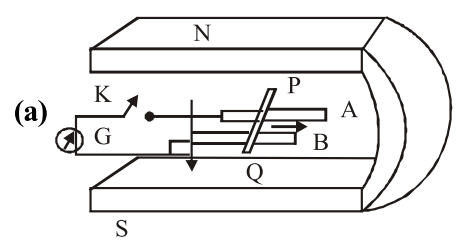
Figure shows a metal rod PQ resting on the smooth rails AB and positioned between the poles of a permanent magnet. The rails, the rod, and the magnetic field are in three mutual perpendicular directions. A galvanometer G connects the rails through a switch K.

Length of the rod = 15 cm,
B = 0.50 T,
resistance of the closed loop containing the rod = 9.0 mΩ.
Assume the field to be uniform.
Suppose K is open and the rod is moved with a speed of 12 cm s⁻¹ in the direction shown. Give the polarity and magnitude of the induced emf.
(b) Is there an excess charges built up at the ends of the rods when K is open? What if K is closed?
(c) With K open and the rod moving uniformly, there is no net force on the electrons in the rod PQ even though they do experience magnetic force due to the motion of the rod. Explain.
(d) What is the retarding force on the rod when K is closed?
(e) How much power is required (by an external agent) to keep the rod moving at the same speed (= 12 cm s⁻¹) when K is closed? How much power is required when K is open?
(f) How much power is dissipated as heat in the closed circuit? What is the source of this power?
(g) What is the induced emf in the moving rod if the magnetic field is parallel to the rails instead of being perpendicular?
Electromagnetic Induction – Solved Example
Given Data: Length of rod \(L = 15 \,\text{cm} = 0.15 \,\text{m}\), Magnetic field \(B = 0.50 \,\text{T}\), Speed \(v = 12 \,\text{cm/s} = 0.12 \,\text{m/s}\), Resistance \(R = 9.0 \,\text{m}\Omega = 9.0 \times 10^{-3}\,\Omega\).
Reference Figure
The setup of the problem is shown below:

(a) Induced emf
\(\varepsilon = B L v = 0.50 \times 0.15 \times 0.12 = 9.0 \times 10^{-3}\,\text{V} = 9\,\text{mV}\)
Polarity: P positive, Q negative.
(b) Charge build-up
K open: Excess charges accumulate at rod ends until induced electric field cancels the magnetic force.
K closed: No sustained charge build-up; charges drift continuously as current flows.
(c) Why no net force on electrons (K open)
Magnetic force: \(F_B = q(\mathbf{v} \times \mathbf{B})\). Electric force from charges: \(F_E = qE\). At equilibrium, \(F_B + F_E = 0\). Hence, net force = 0.
(d) Retarding force (K closed)
Current: \(I = \dfrac{\varepsilon}{R} = \dfrac{B L v}{R}\)
Force: \(F = I L B = \dfrac{B^{2} L^{2} v}{R}\)
\(F = \dfrac{0.50^{2} \times 0.15^{2} \times 0.12}{9 \times 10^{-3}} = 0.075 \,\text{N}\)
(e) External power required
\(P = F v = \dfrac{B^{2} L^{2} v^{2}}{R} = 0.009 \,\text{W} = 9 \,\text{mW}\)
K open: \(P = 0\) (no current flows).
(f) Heat dissipation
\(P_{\text{heat}} = I^{2} R = \dfrac{\varepsilon^{2}}{R} = 0.009 \,\text{W}\)
Source: Mechanical work done by external agent moving the rod.
(g) If B is parallel to rails
\(\varepsilon = B L v \sin\theta\)
For \(\theta = 0^\circ\), \(\sin 0 = 0 \implies \varepsilon = 0\).